



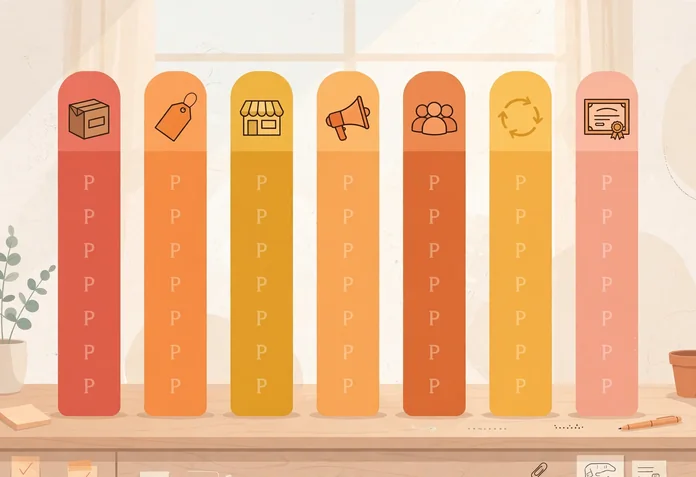
Most marketing problems are not promotion problems. An owner says enquiries have dried up and reaches for more advertising, when the real fault sits somewhere quieter: the offer no longer matches what buyers want, the price signals the wrong thing, the product is hard to buy, or the service experience contradicts every promise the adverts made. The marketing mix exists to stop that guessing: a short checklist of the decisions that together decide whether a business wins or loses its market.
This guide explains all seven Ps in owner language: what each controls, what it looks like in a small business, and the failure mode when it is neglected. It also covers the original 4 Ps, the 4 Cs that restate the mix from the customer side, and a self audit you can run in one sitting.
In short: the 7 Ps of marketing
- Product: what you sell and the problem it solves, including quality, features, range and the service wrapped around it.
- Price: what you charge and how you charge it, including discounts, payment terms and what the price signals about quality.
- Place: where and how customers can buy from you, from a shop or office to a website, a marketplace or a partner.
- Promotion: how people learn about you and are persuaded to act, including advertising, content, public relations and offers.
- People: everyone who shapes the customer experience, from the owner answering the phone to staff, partners and other customers.
- Process: how the service or purchase actually runs, from first enquiry to delivery, payment and follow up.
- Physical evidence: the tangible proof customers use to judge an intangible service, such as premises, documents, reviews and packaging.
Where the mix came from: the 4 Ps, then the 7 Ps
The marketing mix began as four Ps. The American academic E. Jerome McCarthy set out product, price, place and promotion in his 1960 textbook Basic Marketing: A Managerial Approach, and the framework spread because it turned a sprawling subject into four decisions any manager could hold in mind at once. For businesses selling physical goods through shops, four questions were nearly enough: what do we sell, what do we charge, where is it stocked, and how do we tell people about it.
Services broke the model. A haircut, an accountancy service or a training course cannot be inspected before purchase, is produced and consumed at the same time, and is judged heavily on who delivers it and how it feels to buy. In 1981, Bernard Booms and Mary Bitner answered that gap by extending the mix to seven Ps, adding people, process and physical evidence for services marketing. The extended version is the one professional bodies still teach: the Chartered Institute of Marketing guide to the 7 Ps presents all seven as a framework for planning and evaluating marketing strategy, and for checking that what a business plans matches what customers expect.
Two habits make the framework useful rather than academic. First, treat it as a set of decisions, not a poster: each P names something an owner actually sets, spends on or supervises. Second, treat the seven as connected. A premium price with a shabby process, or generous promotion behind a weak product, is not a mix, it is a contradiction, and customers find contradictions quickly. The foundations underneath the mix, including what marketing is and how the working process runs, are covered in Marketing Basics for Business Owners: What Marketing Is and How It Works.
The original four Ps
1. Product: what you sell, and what buyers think they are buying
What it decides: Product covers the offer itself: the core benefit the buyer gets, the features that deliver it, quality level, range, packaging or presentation, guarantees, and the extras wrapped around the core, such as support, delivery or advice. It also decides what you deliberately do not sell, because a range stretched too thin serves nobody well.
Owner example: A bookkeeping firm sells monthly peace of mind, not data entry. Its product decisions include which clients it serves, what the monthly package includes, how quickly queries are answered, and whether payroll and VAT filings are inside or outside the fee. Two firms on the same street can charge very different prices because their products, correctly understood, are different.
Failure mode: The neglected product P shows up as marketing that works once and never again. Ads bring buyers, buyers find an offer that does not match the promise or the need, and reviews quietly undo the promotion. When enquiries convert poorly despite healthy traffic, audit the product before touching the promotion budget.
2. Price: what you charge, and what the number says
What it decides: Price is the only P that brings money in; the rest mostly spend it. It covers the level, the structure (fixed fee, hourly, per item, subscription), discounts and when they are allowed, payment terms, and the signal the price sends. Buyers use price as a shortcut for quality when they cannot judge quality directly, which is most of the time in services.
Owner example: A training provider moves from a low day rate, which made corporate buyers suspicious about depth, to a higher rate with a clear agenda, materials and a follow up session included. The enquiries that resulted were fewer and far better qualified, because the price now agreed with the product story instead of arguing with it.
Failure mode: Discounting by default. A business that reaches for a price cut at every hesitation trains buyers to wait, erodes the margin that funds good people and good process, and often misdiagnoses the problem: most stalled sales are clarity problems or trust problems wearing a price disguise. If price is your main worry, the wider profit picture in How to Make a Business Profitable is the right companion read.
3. Place: where buying happens
What it decides: Place is distribution: the channels and locations through which a customer can actually buy. For a retailer it is the shop, the website and the marketplaces. For a service it is the office, the service area, the booking system, and the partners who resell or refer. Place also covers availability details that lose sales silently, such as opening hours, delivery areas and stock or diary capacity.
Owner example: A physiotherapy clinic discovers that most enquiries arrive in the evening, when its phones are closed and its online booking only offers daytime slots. Nothing about its product or price changed; adding evening appointments and letting patients book them online filled the diary. The mix problem was place, wearing the disguise of weak demand.
Failure mode: Being excellent and unavailable. Businesses lose more sales to friction than to competitors: forms that fail on phones, unclear service areas, no way to buy outside office hours. Every step between wanting and paying is part of place, and every step leaks buyers.
4. Promotion: how people hear and are persuaded
What it decides: Promotion is communication with intent: advertising, content, search visibility, social media, public relations, events, direct mail and offers. Its job is to make the right people aware, interested and confident enough to act. Promotion is the P owners reach for first and the one the framework deliberately puts fourth: it amplifies the other Ps, good or bad.
Owner example: A garden design studio stops boosting random project photos and instead promotes one clear thing each season: a fixed price consultation, explained in a short guide answering the questions clients always ask, shared through search, social and past client email. Promotion spend fell and consultation quality rose, because the message finally matched the product. The range of promotional approaches, and how to choose between them, is compared in Types of Marketing: The Main Approaches and How to Choose.
Failure mode: Promotion asked to do the other Ps jobs. No campaign can sustainably sell the wrong product, at the wrong price, in the wrong place. When promotion underperforms, the honest check is whether it is failing, or faithfully broadcasting a failure elsewhere in the mix.
The three service Ps
5. People: everyone the customer meets
What it decides: People covers everyone who shapes the buying and using experience: the owner, front line staff, subcontractors, support teams, and even other customers, whose behaviour in a waiting room, class or online group colours how the service feels. It includes hiring, training, scripts and standards, and how staff are empowered to fix problems on the spot.
Owner example: A dental practice can buy the same equipment as the clinic across town. What patients actually remember, review and recommend is the receptionist who explains costs before treatment, the nurse who notices anxiety, and the dentist who phones the next day. The practice that trains and scripts those moments is making a marketing decision, whether it calls it one or not.
Failure mode: Marketing promises a premium experience that staffing cannot deliver. One dismissive phone call can waste a month of good promotion, because buyers believe people over adverts every time. If reviews praise the outcome but criticise the manner, the people P is where the repair budget belongs.
6. Process: how buying and delivery actually run
What it decides: Process is the journey a customer travels: enquiry, quote, booking, payment, delivery, onboarding, follow up and complaint handling. It includes waiting times, paperwork, the number of steps, what the customer is told at each stage, and what happens when something goes wrong. Process is where good intentions either become a system or evaporate.
Owner example: A kitchen installer maps the steps between a signed contract and a finished kitchen and finds fourteen silent gaps where the customer hears nothing and starts to worry. Adding three scheduled update messages, a named contact and a snagging visit at the end costs almost nothing and transforms referrals, because customers recommend businesses that kept them informed, not just businesses that fitted units well.
Failure mode: A process that only works when the owner personally pushes it. If quotes wait for one person, if follow up depends on memory, or if complaints disappear into an inbox, growth makes the experience worse instead of better. Process failures are quiet in accounts and loud in reviews.
7. Physical evidence: the proof customers can see and touch
What it decides: Services are promises, so customers hunt for tangible clues about quality before they commit: premises and vehicles, uniforms, documents and invoices, the website, proposals, packaging, certificates, case studies and reviews. Physical evidence is everything a buyer can inspect that stands in for the thing they cannot inspect, which is the future service itself.
Owner example: A commercial cleaning firm wins contracts not with cheaper quotes but with better evidence: a clear proposal naming the schedule and standards, staff identification, insurance documents, and a monthly report with inspection notes. The buyer cannot test the cleaning in advance, so the firm makes professionalism visible on paper before it is visible in the building.
Failure mode: Evidence that contradicts the pitch. A premium consultancy with a typo filled proposal, a luxury salon with a shabby waiting area, or a web firm whose own site is slow and dated: each tells the buyer that the promise is marketing rather than fact. Audit the evidence a prospect sees in the first five minutes and ask whether it proves or undermines your price.
The 4 Cs: the same mix from the customer side
In 1990 the advertising executive Robert Lauterborn argued, in an Advertising Age piece tellingly titled as a call to retire the 4 Ps, that the mix describes the business view and should be restated from the buyer side. His 4 Cs map one to one onto McCarthy original four: product becomes customer wants and needs, price becomes cost to satisfy, place becomes convenience to buy, and promotion becomes communication. The scholarly summary of Lauterborn’s 4 Cs in the Springer reference literature makes the point plainly: the model places emphasis on the customer viewpoint rather than the organisation viewpoint.
| The business view (P) | The customer view (C) | The question it forces |
|---|---|---|
| Product | Customer wants and needs | What problem is the buyer actually trying to solve? |
| Price | Cost to satisfy | What does buying really cost the customer in money, time, effort and risk? |
| Place | Convenience to buy | How easy is it to find, evaluate and buy, in the customer’s circumstances? |
| Promotion | Communication | Is this a one way sales message, or a two way conversation the customer can answer? |
The mapping is more than wordplay, because each C widens its P. Cost to satisfy includes the buyer time, travel, learning curve and risk, not just the invoice; a cheaper offer that wastes a day can be the expensive option. Convenience asks whether place works for this customer, at this hour, on this device. Communication demotes promotion from broadcast to dialogue, which is how buying actually works now: reviews, replies and answers persuade more than announcements. Run the 4 Cs over any planned change and the gaps in the Ps become visible fast.
How the Ps interact
No P works alone, and the most expensive marketing mistakes are mismatches between them. Price and product must agree: a high price is a promise that the product, people and evidence have to keep. Promotion and process must agree: a campaign that doubles enquiries into a diary or inbox that cannot respond creates disappointed buyers at scale. Place and people must agree: opening a new channel, such as online booking or a marketplace, changes what staff must do and know.
A useful test is to read your mix as a customer story in one pass. A buyer hears a promise in promotion, checks it against evidence, meets people, travels the process, pays the price and receives the product. At every hand over between Ps, ask whether the story stays consistent. Businesses rarely fail on one P in isolation; they fail at the joins, where the advert says premium, the quote looks cheap, the reply takes three days, and the buyer quietly concludes the promise was never real.
Auditing your own mix: a one sitting checklist
Work through the seven questions below with evidence in front of you, not impressions. Score each P honestly from one to five, then fix the lowest score first, because the mix performs at the level of its weakest element, not its strongest.
- Product: Can you state, in one sentence, the problem this offer solves and for whom? When did you last change the offer based on what buyers said?
- Price: Does your price match the quality story your evidence tells? Are discounts governed by rules, or granted case by case under pressure?
- Place: Can a customer complete a purchase or booking at the hour they are most likely to try, on a phone, without calling you?
- Promotion: Does every promotion point to one clear offer and one clear next step? Do you know which activity produced your last ten customers?
- People: Would a mystery enquiry to your own business, by phone and by message, get the response your marketing promises?
- Process: Is the path from enquiry to delivery written down, timed and owned, including what happens when something goes wrong?
- Physical evidence: Do your proposal, premises, website and documents prove the standard you charge for, or quietly argue against it?
- The 4 Cs cross check: What does buying cost the customer beyond the price, and how convenient is it really, from their side of the counter?
Owners usually find one P scoring far below the rest, and it is rarely promotion. Resist fixing the strongest P further; an already good product promoted harder into a broken process only produces disappointed customers faster. Improve the weakest P to the level of the others, then re-audit. That sequence, repeated twice a year, is most of what larger firms pay consultants to tell them.
Common mistakes with the marketing mix
First, treating the mix as a one off exercise, written for a plan and never revisited while the market, costs and competitors move. Second, copying a competitor mix without the competitor resources or customers; the Ps must fit your buyers and your capacity. Third, adding Ps together as if more is always better: an eighth channel, a longer range or a fancier premises can dilute the mix rather than strengthen it. Fourth, forgetting the service Ps entirely because they feel operational rather than marketing, when buyers experience people, process and evidence as the product itself. The mix is a management habit, not a diagram: decide deliberately, keep the seven consistent, and audit them against the customer side with the 4 Cs.
The 7 Ps in practice: one service business, start to finish
To see the mix working as a single system, take a fictional but typical business: a two person physiotherapy clinic competing with a hospital outpatient department and three other private practices. Its owner runs the seven Ps in order. Product: rather than generic treatment sessions, the clinic builds its offer around sports injury recovery, with an assessment, a written recovery plan and a return to sport test, because local runners and amateur footballers cannot get that clarity elsewhere. Price: the assessment is a fixed fee, quoted on the website, and treatment is sold in blocks with the total cost stated in advance, so the price signals organisation rather than meter watching. Place: evening and Saturday appointments, online booking, and a room inside a gym where its target patients already train.
Promotion: one short guide each month answering a recovery question local athletes actually search for, shared with the gym and past patients, instead of generic clinic news. People: both physiotherapists are introduced by name and specialism on the site, reception staff are trained to explain the plan and the costs before the first visit, and the same clinician treats a patient throughout. Process: every new patient receives the plan in writing within a day, progress is measured against it at set points, and a discharge summary closes the loop with the patient and, with permission, their coach or GP. Physical evidence: the recovery plan document itself, progress charts, clean and branded treatment rooms, and reviews that mention the clarity of the plan as often as the treatment.
Notice what the example shows: no single P is remarkable, and the clinic spends less on promotion than its competitors. It wins because the seven agree with each other, and each one was a deliberate decision the owner can name. That is the real use of the framework for a small business. It converts marketing from a search for the next tactic into a periodic review of seven decisions you already control, most of which cost attention rather than advertising money. When something underperforms, the mix also tells you where to look first: read the story from the customer side, find the P where the story breaks, and repair that join before buying more attention for a promise the rest of the mix cannot keep.
Frequently asked questions
What are the 7 Ps of marketing?
The 7 Ps are product, price, place, promotion, people, process and physical evidence. The first four are the classic marketing mix for goods; the last three were added for services, where who delivers the service, how it runs and what proof the customer can see all shape the buying decision.
What is the difference between the 4 Ps and the 7 Ps?
The 4 Ps, product, price, place and promotion, were set out by E. Jerome McCarthy in 1960 and fit businesses selling physical products. The 7 Ps keep those four and add people, process and physical evidence, which Booms and Bitner proposed in 1981 because services are judged on delivery and proof, not only on the offer itself.
What are the 4 Cs of marketing?
The 4 Cs restate the original 4 Ps from the customer’s side: customer wants and needs instead of product, cost to satisfy instead of price, convenience to buy instead of place, and communication instead of promotion. Robert Lauterborn proposed them in 1990 to push businesses to plan from the buyer’s viewpoint.
Does a business that sells products need the 7 Ps, or are 4 enough?
Most product businesses still benefit from all seven. Even where the item itself is physical, buyers judge the people who serve them, the process of ordering and delivery, and the evidence around quality, such as packaging, documents and reviews. The service Ps matter in proportion to how much service surrounds the product.
Which P should a small business fix first?
Fix the weakest one, because the mix performs at the level of its lowest element. Audit all seven with evidence, score them honestly, and improve the lowest score before spending more on the strongest. Owners often expect the answer to be promotion, but product clarity, price signals and process gaps are more common culprits.
How often should a business review its marketing mix?
Twice a year is a workable rhythm for most small businesses, plus a quick review whenever something material changes, such as a price rise, a new channel, a key staff change or a shift in what competitors offer. The audit is short: seven questions, honest scores, and one weakest P chosen for improvement.
