



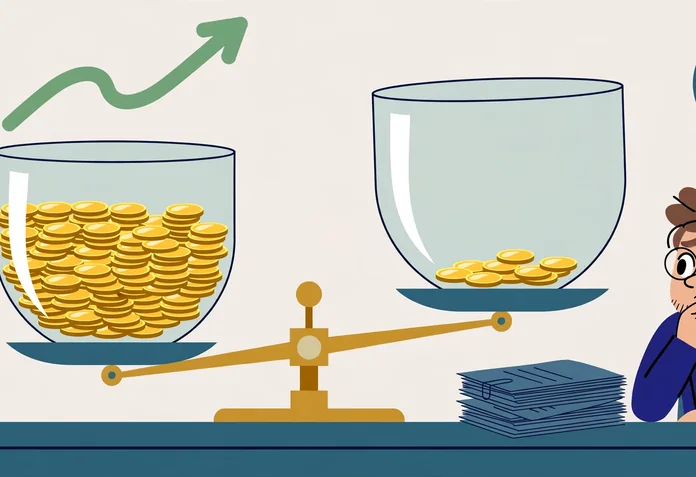
Your accountant says the month made a profit. Your bank account says something else, and payroll is due on Friday. Both can be right at the same time, because profit and cash flow are not two names for the same thing. Profit counts work when it is earned and costs when they are incurred. Cash flow counts money when it actually arrives and leaves, and a customer who pays sixty days after the invoice creates a gap between the two that no amount of optimism closes. This guide explains where the money goes in that gap, why the reverse also happens, and the short monthly routine that lets an owner watch both numbers at once.
In short: cash flow vs profit
Profit and cash flow measure the same business through two different clocks. Profit uses the earning clock: income counts when the work is done, costs count when they are used. Cash flow uses the bank clock: money counts when it moves. Neither figure is wrong, and neither is complete alone.
- Profit: revenue earned minus expenses incurred in a period. It answers whether the business model works at the prices charged.
- Cash flow: cash received minus cash paid in the same period. It answers whether the business can pay what falls due, when it falls due.
- The gap: unpaid invoices, stock, equipment, loan repayments and tax move the two figures at different times, sometimes by months.
- The habit: read both together, over several months, and treat any gap you cannot explain as a question to answer, not a mystery to accept.
The two definitions, in plain language
Profit is what is left of the revenue a business earns after the expenses of earning it are deducted. Sell work for 10,000 currency units, use 8,000 currency units of labour, materials and overhead to deliver it, and the profit is 2,000, whether or not anyone has paid yet. Profit lives on the income statement, also called the profit and loss statement, and its bottom line figure is net income. The formula is simple: revenue minus expenses equals profit. The catch sits in the timing of the two words revenue and expenses, which the next section covers.
Cash flow is the movement of money into and out of the business over the same period: cash received from customers, owners and lenders, minus cash paid to staff, suppliers, lenders and the tax authority. It lives on the cash flow statement, and the U.S. Small Business Administration, in its Manage your finances guide, treats that statement, the balance sheet and the income statement as the three reports an owner needs to run the finances rather than guess at them. Cash flow is usually read in three parts:
- Operating cash flow: money from trading itself, customer receipts against wages, rent, suppliers and tax.
- Investing cash flow: money spent on or raised from long term assets, above all equipment and vehicles.
- Financing cash flow: money from loans and owners, and money returned to them as repayments, interest in some presentations, and drawings or dividends.
The SBA Ascent learning programme makes the same point about timing in its financial statements tool (PDF): a cash flow statement maps when sales are paid and when bills fall due, which is exactly the information the profit figure leaves out. Profit tells you the work was worth doing. Cash flow tells you whether you can still be trading while you wait to be paid for it.
Why timing separates them: the accrual idea
Most established businesses keep their books on the accrual basis, which means a sale is recorded when the work is delivered and invoiced, not when the money lands, and a cost is recorded when it is incurred, not when it is settled. The accounting education site AccountingCoach, answering the question of how a company can have a profit but not have cash, puts it in one line: under accrual accounting, revenues are not receipts and expenses are not payments. Everything in this article follows from that sentence.
Accrual accounting exists for a good reason. It matches the cost of a job to the income from that job, so the profit figure shows whether the job itself was priced and run well. A cash-only view would call the month the customer finally pays a triumph and the month the work was done a disaster, which teaches the owner nothing about pricing. The price of that clarity is the gap this article is about: the profit figure can look healthy for weeks before the cash arrives, and the owner who reads only the profit figure will feel richer than the bank account allows.
One qualification, because it changes how some readers should use this guide. Smaller businesses in some places keep books, or file taxes, on a cash basis, recording income when it arrives and costs when they are paid. If that is you, your recorded profit already follows the bank more closely, and the gap described here is smaller in your reports. It has not vanished from your business, though: the work you have done and not yet billed, and the bills sitting in the drawer, are still real. Read the rest of this article as a guide to the underlying timing, whichever basis your books use.
A worked example: profitable in March, short of cash until May
All figures in this example are illustrative, in generic currency units, chosen to make the timing visible rather than to describe any real business.
In March, a small services firm completes a project and invoices the client 10,000 currency units on 60 day terms, so payment is due at the end of May. To deliver the project in March, the firm pays wages of 3,500 and materials of 3,000 during the month, pays rent of 1,000, and records 500 of depreciation on equipment it already owns. Nothing else happens. Now read the month both ways:
- Profit for March: revenue of 10,000 minus expenses of 8,000 (3,000 materials, 3,500 wages, 1,000 rent, 500 depreciation) equals a profit of 2,000.
- Cash flow for March: cash received, 0. Cash paid, 7,500 (the depreciation is not a payment, so it stays out). Operating cash flow is negative 7,500, and the bank balance falls by that amount.
- End of May: the client pays 10,000. Cash flow for that month is strongly positive, but no new profit is recorded for the project, because the revenue was already counted in March.
Nothing has gone wrong in that story. The client is good, the project was priced properly, and the profit is real. The firm simply has to fund roughly two months of costs out of whatever cash it held in February. Multiply the example by a growing order book, where every month adds a bigger invoice that will not be paid for 60 days, and you have the classic pattern behind the phrase profitable but broke: growth on credit terms consumes cash precisely because it is succeeding. The AccountingCoach explanation of the cash flow statement shows how the statement itself bridges the two figures, starting from net income and adjusting it for exactly these timing differences, which is why the two reports are designed to be read together.
The five bridges between profit and cash
Every gap between a business profit and its bank balance crosses one of five bridges. When the two figures disagree, work through these five before suspecting an error; in most months, one or two of them explain the whole difference.
1. Unpaid customer invoices
A sale on terms records revenue and profit immediately and cash not at all. The amount owed sits on the balance sheet as receivables, which is why our guide to why a balance sheet matters for a small business treats the receivables figure as one of the first numbers an owner should read: it is profit you have earned but cannot yet spend. The longer your customers terms, and the faster your sales grow, the larger this bridge becomes. It is also the bridge most in the owner control, through deposits, milestone billing and prompt collection, which is a cash decision rather than a profit decision.
2. Stock and work in progress
Money spent on materials and stock leaves the bank account when you buy, but it only becomes an expense in the profit calculation when the stock is used or sold. A business building stock for a busy season can spend heavily for two months while its profit figure barely moves, then show strong profit later when the stock sells, in a month when little new cash goes out. Work in progress does the same to service businesses: wages paid on a half finished project are cash gone, while the revenue may not be recordable until a milestone or completion. The cash has not been lost. It is sitting in a storeroom or an unfinished job, and it will only turn back into cash when the work is finished, invoiced and paid, three separate events with three separate dates.
3. Supplier payment timing
The same bridge, crossed in the other direction. A cost is recorded when the goods or services are received, but the cash leaves when the supplier is paid, which may be 30 or 60 days later. In the month the cost lands, profit falls and cash does not, so supplier terms flatter the bank balance in exactly the way customer terms punish it. This is why the two terms have to be read together: a business that pays suppliers in 14 days and is paid by customers in 60 has built a funding gap into every sale, whatever its margins look like. Stretching suppliers beyond the agreed terms narrows the gap on paper and widens it in reality, because the bill, and usually the relationship damage, arrives anyway.
4. Equipment buying and depreciation
Buy a machine for 12,000 currency units and the bank account falls by 12,000 at once, or by the deposit and instalments if it is financed. The profit figure does not fall by 12,000 in that month. Instead, the cost is spread over the machine’s useful life as depreciation, a few hundred units a month in this illustration. Depreciation is the profit system recognising that the machine is being used up gradually, and it is a real cost; it is simply not a payment. This bridge explains two common confusions: the owner who feels the accounts are ignoring a huge purchase (they are spreading it, not ignoring it), and the owner who treats depreciation as free money because it is non cash (the machine will still need replacing, in cash, one day).
5. Loans, owner money and tax
Financing movements cross no profit bridge at all in one direction and a narrow one in the other. A loan arriving in the account is cash in, but it is not revenue and not profit; it is a debt. Repaying the loan principal is cash out, but it is not an expense in the profit calculation; only the interest is. Owner money follows the same pattern: cash an owner puts in is not sales, and drawings an owner takes out are not wages or costs in most small business structures, so both can move the bank balance a long way while the profit figure sits still. Tax completes the set: profit is calculated as the year unfolds, but tax is often paid in lump sums months later, so a profitable year can end with a tax payment that the cash position was never visibly reserving for. Profitable businesses are caught by this bridge every year, usually in the month the payment falls due.
The opposite case: cash in the bank, losses on paper
If profit without cash surprises owners, cash without profit misleads them, because a rising bank balance feels like success. There are five common ways to be cash positive while losing money, and each one is either temporary or creates a later obligation:
- New borrowing. A loan lifts the balance the day it lands and says nothing about trading. The test is what the balance does in the months after the loan is spent.
- Owner injections. Cash the owner adds keeps the business funded, but it is the owner subsidising the model, not the model working.
- Asset sales. Selling a vehicle or spare equipment converts an asset into cash once. The profit figure records only any gain or loss on the sale, not the full proceeds, and the asset is gone.
- Customer deposits and advance payments. Money received for work not yet delivered is cash held against a duty to do the work. The costs of doing it are still to come, so the balance overstates what is truly available.
- Delaying payables. Holding supplier, tax or other payments back keeps cash in the account this month by moving the outflow to a later one, where it arrives with interest, penalties or a damaged supplier relationship attached.
None of these makes a business dishonest or doomed; most healthy businesses use some of them deliberately, a loan for equipment, deposits as standard terms, supplier terms agreed in advance. The danger is reading the resulting bank balance as trading performance. A quarter in which cash rose only because of a loan and a deposit, while the profit figure fell, is a quarter in which the business consumed future capacity. The two figures read together show that immediately. Either figure read alone hides it.
Cash flow vs profit, side by side
| Question | Profit | Cash flow |
|---|---|---|
| What it counts | Revenue earned and expenses incurred in the period | Cash received and cash paid in the period |
| When a credit sale counts | When the work is delivered and invoiced | When the customer actually pays |
| Where it is reported | Income statement (profit and loss) | Cash flow statement, in operating, investing and financing parts |
| What it can hide | How long you will wait to be paid, and what lump sums are coming | Whether the underlying work was priced well enough to be worth doing |
| What moves it without moving the other | Depreciation and other non cash costs | Loans, owner money, equipment purchases, tax payments and loan repayments |
| The decision it guides best | Pricing, margins and whether the model works | Whether wages, suppliers and tax can be paid on time |
Which number for which decision
Pricing and margin decisions belong to the profit figure. Whether a job is worth taking, a price needs raising or a cost line is eating the business is a question about revenue against the full cost of earning it, including costs that do not leave the bank this month, such as depreciation. Our guide to how to make a business profitable works through those levers in order. Deciding prices from the bank balance instead produces the classic error of feeling comfortably busy while quietly undercharging.
Survival decisions belong to the cash figure. Payroll dates, supplier payments, rent and tax do not accept a profit figure in settlement. Whether the business can commit to a new hire, a bigger premises payment or a stock order this month is a question about money in, money out and the dates on both, which only the cash view answers. This is also why the cash question is always about a period, not a day: a healthy balance today with a tax payment and payroll in the same week next month is not a healthy position.
Borrowing and growth decisions need both, over time. A lender will ask for both reports because they answer different halves of the lending question: profit shows the business can generate a surplus worth lending against, and cash flow shows it can service repayments on schedule. Growth decisions deserve the same pairing. Growth that raises profit while consuming more cash each month, through longer stock holding and more credit sales, needs funding arranged before the gap arrives, not discovered after it has.
The monthly owner review: five numbers, under an hour
None of this requires accounting training. It requires the same short routine, run monthly, on figures your records already hold. The steps of producing those figures are set out in our guide to the accounting cycle steps for a small business, and what a bookkeeper actually does for a small business covers who typically maintains them. The review itself is five checks:
- The profit figure for the month, and for the year so far. Is the model producing a surplus at current prices and costs?
- The bank balance today, against the same day last month. Not the direction of sales, the direction of money.
- The receivables list, aged. Who owes the business, how much, and how old is each debt? This is next month cash, already earned, waiting on other people’s habits.
- The payments already committed for the next few weeks. Payroll, rent, supplier runs, loan repayments and any tax falling due, listed with dates.
- A rolling cash forecast for the next 13 weeks. Our guide to building a rolling 13-week cash-flow forecast sets out the method: opening balance, expected receipts by week, committed payments by week, updated weekly so the tight weeks show up while there is still time to act on them.
Once a quarter, close the period properly before reviewing it: reconciliations done, receivables and payables reviewed, the three reports read together. Our quarterly finance close checklist gives that routine in order, and it is what turns this monthly habit from a glance at the bank into a reliable picture. The question that ties the whole review together is the one from the opening of this article: if we made a profit, where is the money? After a few months of the routine, you will be able to answer it bridge by bridge, in minutes.
What healthy looks like over a period
Over a single month, profit and cash flow can disagree wildly for entirely healthy reasons: a big invoice issued, a machine bought, a tax payment made. Over a longer period, a year of trading, a healthy business shows a recognisable pattern: profit that mostly converts into operating cash, with the gaps explainable by named bridges. Receivables grow in line with sales, not faster. Stock turns over rather than ageing. The financing section is quiet in ordinary months, because trading, not borrowing, is funding the business.
The warning pattern is the mirror image: reported profits that never seem to arrive as cash, a receivables list ageing faster than sales grow, and regular rescue cash from loans or the owner. That pattern does not prove anything is wrong; it proves the bridges need examining one by one, because somewhere between the invoice and the bank account, value is leaking or stalling. Judge your business on the pattern across several months, never on either figure for a single month, and never on the bank balance alone on a good day.
Sources used for this article
- U.S. Small Business Administration, Manage your finances (business guide): https://legacy.sba.gov/business-guide/manage-your-business/manage-your-finances
- U.S. Small Business Administration (SBA Ascent), Your Business Financial Strategy: Financial Statements and Business Growth Decisions (PDF tool): https://ascent.sba.gov/8d/4b/6855ceed413ca6384044018eb2f6/your-business-financial-strategy-2-3-financial-statements-business-growth-decisions-tool.pdf
- AccountingCoach, How can a company have a profit but not have cash?: https://www.accountingcoach.com/blog/how-can-a-company-have-a-profit-but-not-have-cash
- AccountingCoach, Cash Flow Statement: In-Depth Explanation with Examples: https://www.accountingcoach.com/cash-flow-statement/explanation
Frequently asked questions
What is the difference between cash flow and profit?
Profit is revenue minus expenses for a period, recorded when income is earned and costs are incurred. Cash flow is the money that actually moves in and out of the business in the same period. The two differ because invoices, stock, equipment, loans and tax all move cash and profit at different times.
Can a business be profitable but have negative cash flow?
Yes. When sales are made on credit terms, the profit is recorded at once but the cash arrives weeks later, while wages, rent and suppliers may have to be paid now. Growth makes it more likely, because more sales on terms means more money owed to the business at any moment.
Can a business have positive cash flow and still be unprofitable?
Yes. A loan, an owner contribution, an asset sale or a customer deposit all bring cash in without being profit, and delaying supplier payments holds cash back for a while. Each source is temporary, or creates a duty to deliver work, repay money or settle the bill later.
Is cash flow the same as net income?
No. Net income is another name for the profit figure at the bottom of the income statement. Cash flow is measured by the cash flow statement, which starts from that profit and adjusts it for money that moved at a different time, such as unpaid invoices, depreciation, equipment purchases and loan repayments.
Which matters more, cash flow or profit?
Neither, on its own. Profit shows whether the business model works at the prices charged; cash shows whether the business can pay what falls due this week. Businesses fail from lack of cash, but a business that never turns its trading into profit is borrowing from its own future. Owners need both, read together over several months.
What should an owner review each month to see both clearly?
The profit and loss for the month, the bank balance today, the list of who owes the business money and how old those debts are, the payments due in the next few weeks, and a rolling cash forecast for the next quarter. Together they take under an hour to review, once the records behind them are kept current.
