



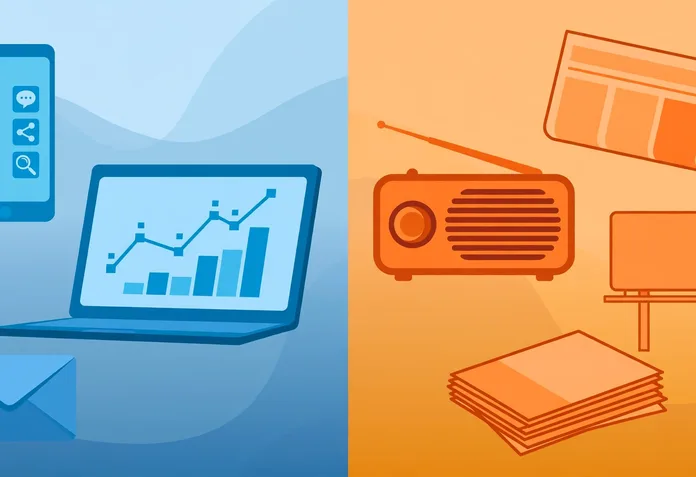
Every small business owner eventually faces the same budget question: should the next chunk of marketing money go into Google and social media ads, or into flyers, radio spots and local newspaper ads? The honest answer is that neither side wins on every measure. Digital marketing is cheaper to start, easier to target and far easier to measure. Traditional marketing still reaches people in the physical world, builds local trust and connects with audiences that barely use the internet. This guide compares the two side by side on cost, reach, targeting, measurement, engagement and return on investment, then shows how to combine both instead of picking a side.
In short: digital marketing promotes your business through internet channels such as search, social media, email and your website, while traditional marketing uses offline media such as print, radio, television, billboards and direct mail. Digital usually costs less to test, targets specific audiences and reports results in near real time, so its return is easier to prove. Traditional costs more and is harder to track, but it still earns attention and trust in local markets, with older audiences and in physical places. Most small businesses do best with a digital first mix, keeping a deliberate slice of traditional spend for where their customers live and shop.
What counts as digital marketing and what counts as traditional
The dividing line is the medium. Traditional marketing is promotion delivered offline, through channels that existed long before the internet. Digital marketing is promotion delivered through the internet or an electronic device. Our guide to the main types of marketing shows where each of these sits alongside approaches such as word of mouth and event marketing.
Traditional marketing channels
- Print advertising in newspapers and magazines
- Television and radio commercials
- Billboards, posters, signage and vehicle wraps
- Flyers, brochures and leaflet drops
- Direct mail, such as postcards and catalogues sent to homes
- Cold calling and telemarketing
- Trade shows, local events and sponsorships
- Business cards, branded merchandise and in-store displays
Digital marketing channels
- Your website and search engine optimisation (SEO), which helps it rank on Google
- Pay per click advertising, such as Google Ads and paid social media ads
- Social media marketing on platforms such as Facebook, Instagram, LinkedIn and TikTok
- Email marketing and SMS campaigns to your own customer list
- Content marketing, including blog posts, videos and guides
- Influencer and affiliate marketing
- Online listings and reviews, such as a Google Business Profile
Some channels blur the line: a local radio station also streams online, and a newspaper sells space on its website. What matters for your budget is not the label but how the channel behaves: what it costs, who it reaches, how precisely you can aim it and whether you can tell if it worked.
Digital vs traditional marketing at a glance
The table below sums up the practical differences that matter when you are the one paying. The sections after it explain each row in more depth.
| Factor | Digital marketing | Traditional marketing |
|---|---|---|
| Definition | Promotion through internet and electronic channels: search, social media, email, websites, apps and online video. | Promotion through offline media: print, television, radio, billboards, direct mail, flyers and events. |
| Cost | Low entry cost and flexible budgets. You can start with a small daily ad spend and pause anytime, though competitive keywords and audiences push prices up. | Higher fixed costs. Print runs, airtime, billboard rental and postage are usually bought in blocks, with design and production on top. |
| Reach | Local, national or global from the same account. A small firm can reach buyers in other cities and countries without extra media buys. | Mostly local or regional, set by a newspaper circulation, a radio station footprint or a billboard location. National coverage is possible but expensive. |
| Targeting | Precise. Aim by location, age, interests, behaviour and, most powerfully, search intent: what a person is looking for right now. | Broad. You choose a publication, programme or place whose audience roughly matches your customers, and everyone else sees the ad too. |
| Measurement | Detailed and fast. Clicks, calls, form fills and sales are tracked per campaign, often within hours. | Estimated and slow. Results are inferred from circulation figures, listener surveys, coupon returns and footfall changes. |
| Engagement | Two way. Customers can reply, comment, share, message and buy in the same place they saw the message. | One way. The audience receives the message but cannot respond through the medium itself. |
| Speed | Live in hours. Ads can be edited, paused or scaled the same day, and a weak message can be replaced mid campaign. | Slower to launch and hard to change. Print deadlines, production lead times and booked airtime mean mistakes run their course. |
| Lifespan of impact | Mixed. Paid ads stop the moment you stop paying, but content, SEO and email lists keep working for months or years. | Short for each placement: a flyer is read once, an ad airs for seconds. Repeated exposure in a fixed place, such as a billboard, builds recall over time. |
| Best for | Measurable leads and sales, tight budgets, testing offers, selling beyond your local area and reaching people who research online before buying. | Local visibility and trust, older or less connected audiences, physical products people want to see, and a daily presence on the routes your customers travel. |
Cost: where the money actually goes
Cost is the difference most owners feel first. Digital marketing has a low floor: open an ad account, set a modest daily budget and you can be in front of customers the same day. If the ad flops, you pause it and lose only what you spent finding out. The organic side is flexible too. A Google Business Profile, social media pages and an email list cost time more than money, and the digital marketing tools a small business actually needs mostly come in free or low cost tiers.
Traditional marketing works the other way round. The costs are fixed before anyone sees your message: design and printing for flyers, studio time and airtime for radio, billboard rental, postage for direct mail. A single placement in a popular local newspaper or a month on a well placed billboard can cost more than several months of a small firm’s digital budget, and you pay the same whether it brings in two customers or two hundred. That does not make it wasteful, but it raises the stakes of getting the message and placement right first time.
Two cautions keep this honest. First, digital is not automatically cheap: in competitive markets, clicks for valuable searches such as legal or home services can cost serious money. Second, traditional costs buy something digital struggles to copy: physical presence. A flyer on a fridge door or a sign on a busy junction keeps working in front of the same local audience every day without a per click charge. The real question is not which is cheaper in total, but which wins you a customer for less in your market.
Reach and targeting: broad brush versus scalpel
Traditional media reaches whoever happens to be there. A radio ad reaches the station’s listeners, a billboard reaches drivers on that road, a newspaper ad reaches that paper’s readers. For a business serving one town, that broad brush is often a feature: the plumber, the bakery and the driving school all want the whole neighbourhood. The weakness is waste. You pay to reach every listener, including the majority who will never buy, and scaling beyond your region gets expensive fast because each new area needs its own placements.
Digital reach starts from a far bigger pool. DataReportal counted 6.12 billion internet users worldwide at the start of April 2026, about 73.8 percent of the world’s population, so even a niche product can find a viable audience online. More important than raw size is control. You can limit ads to people within a few miles of your shop, or expand to a whole country, from the same dashboard. And you can aim by intent: someone searching for “emergency plumber near me” is worth far more than a thousand random impressions, and only digital lets you bid on that moment. Behavioural targeting goes further, showing follow up ads to people who visited your pricing page but did not buy.
The trade off is attention and trust. Online audiences skip ads by reflex and can block them entirely, while a physical ad in a trusted local paper arrives with borrowed credibility. Reach figures also flatter digital: an impression on a screen is not the same as a person noticing your message. Judge reach by how many of the right people you can reach repeatedly at a sensible cost.
Measurement, ROI and speed: knowing what worked
Measurement is digital marketing’s clearest win. Every serious platform reports how many people saw the ad, clicked, called, filled in a form or bought, and what each result cost. If a campaign is losing money, you can see it this week and fix the message, the audience or the offer. That feedback loop is why digital returns are easier to prove. Litmus, in its email marketing ROI research based on marketer surveys, reports that email returns an average of $36 for every $1 spent, higher than any other channel it covers. Treat any single figure as a benchmark rather than a promise, but the point stands: digital channels produce numbers you can audit.
The market has voted with its wallet. Dentsu forecast in its June 2025 global ad spend outlook that digital would account for 68.4 percent of worldwide advertising spend in 2025, while traditional spend would decline by 3.8 percent. Budgets follow measurability and flexibility, especially when money is tight.
Traditional results are real but blurrier. A shopkeeper can see footfall rise during a flyer drop, and a radio station can quote listener estimates, yet tying a specific sale to a specific ad is usually guesswork. Owners work around this with tracking tricks: a unique phone number on the flyer, a coupon code in the newspaper ad, a QR code that opens a dedicated page, or simply asking every new customer how they heard about the business. These methods narrow the gap, and any traditional campaign worth running deserves at least one built in from the start.
Speed matters too. A digital campaign can launch today, gather data by Friday and be rewritten by Monday. A print or broadcast campaign takes days or weeks to produce, runs as booked, and teaches its lessons afterwards. For a business testing a new offer, that difference in cycle time is often worth more than the difference in price.
When traditional marketing still wins
Writing traditional marketing off would be a mistake, and for some businesses it remains the stronger half of the mix.
- You sell to a defined local area. A billboard near your premises, an ad in the community paper or a sponsored local team puts your name in front of the exact streets you serve, including people who rarely search online for what you sell.
- Your customers skew older. Audiences who read print, listen to local radio and watch broadcast television are genuinely reachable there, and many trust those channels more than anything on a phone screen.
- The product benefits from being physical. A well made brochure, a sample, a catalogue left behind after a sales visit or an in-store display keeps selling after you have left the room, in a way a closed browser tab cannot.
- You need mass local awareness quickly. A grand opening, a seasonal sale or a new branch launch can blanket a town with radio, print and outdoor in a way that slow building organic reach cannot match on a deadline.
- Credibility is the bottleneck. Appearing in established local media carries an implied endorsement. For trades and professional services where trust decides the sale, that borrowed authority helps close it.
The pattern in every case is the same: traditional wins when the audience is geographic, the message is simple awareness, and physical presence or trust does the persuading.
When digital marketing wins
Digital is the stronger default in the mirror image situations.
- Your budget is small and must prove itself. You can start with what you can afford, watch the results daily and stop anything that does not pay.
- You need leads or sales you can count. Search ads, a well built website and email follow up turn interest into enquiries you can attribute to a specific campaign. Our walkthrough of how to reach your customers through digital marketing shows how those pieces fit together in practice.
- Your customers research before they buy. For considered purchases, the sale is often won or lost in search results, reviews and comparison content long before a salesperson gets involved.
- You sell beyond your neighbourhood. Online channels remove the geographic ceiling, so a specialist product or service can find buyers nationally or internationally without opening new premises.
- You are testing. New prices, new offers and new messages can be trialled on small audiences in days, so the budget follows evidence instead of opinion.
How a small business can combine both on a real budget
For most small businesses the practical answer is a blend, weighted towards digital because that is where measurement and flexibility live, with traditional spend kept for the local jobs it does best. Here is an example for a local service business, say a home renovation firm, spending $1,500 a month.
- About $975 (65 percent) to digital: local search ads and a maintained Google Business Profile to catch people actively looking, a simple website kept current, before and after photos and short videos on social media, and an email or SMS follow up to past customers and quotes that went quiet.
- About $525 (35 percent) to traditional: a leaflet drop in the streets around recent jobs, a small ongoing ad in the community magazine, signage on the van and at job sites, and a modest sponsorship of a local sports team.
Those percentages are a starting point, not a law. A business selling nationwide online might run 90 percent digital, while a café in a small town might lean harder on local print, signage and radio. What makes the blend work is connecting the two halves so each strengthens the other:
- Put a QR code and a short, memorable web address on every flyer, vehicle and receipt, so offline attention becomes online visits you can count.
- Use a different phone number or extension on traditional ads, so calls from them can be separated from calls generated online.
- Retarget locally: run social ads to people in the same neighbourhoods your leaflets cover, so residents see your name in print and on their phones in the same week.
- Repurpose both ways: turn a popular social video into a talking point in your print ad, and photograph your billboard or sponsorship for social content.
- Review the mix quarterly. Move money towards whichever side produced enquiries at the lower cost, and be willing to cut a long running placement that nobody can tie to a single customer.
A simple decision framework by goal
If you are still torn, decide by the job you need done rather than by loyalty to a channel.
| Your goal | Start with | Why |
|---|---|---|
| Enquiries you can count this month | Digital | Search and social ads reach people ready to act, and every enquiry can be traced to its source. |
| Foot traffic from your own neighbourhood | Traditional, backed by digital | Signage, flyers and local media build street level awareness; your Google profile and reviews close the sale when people check you online. |
| Selling outside your local area | Digital | Only online channels scale nationally or internationally without new premises or media buys in each region. |
| Trust with older or offline customers | Traditional | Print, radio and face to face presence carry credibility with audiences that spend little time online. |
| Testing a new offer or price | Digital | Small test budgets and same week data tell you if the idea works before you commit real money. |
| Long term name recognition on a fixed route or in one town | Traditional | Repeated physical exposure, such as a billboard or vehicle signage, builds recall that paid digital impressions rent rather than own. |
Whichever side you start with, set one measurable target before you spend: enquiries, calls, bookings or sales, plus a way of knowing which channel produced them. Marketing you cannot measure becomes a cost you defend out of habit, and that is true of a boosted post just as much as a billboard.
Frequently asked questions
What is the main difference between digital marketing and traditional marketing?
The main difference is the channel and what flows back. Digital marketing promotes a business through internet channels such as search engines, social media, email and websites, and the communication runs both ways: customers can click, reply, share and buy, and the business can see exactly what they did. Traditional marketing uses offline media such as newspapers, radio, television, billboards and direct mail. The message travels one way, to a broad audience, and the business learns far less about who saw it or what it produced.
Is digital marketing cheaper than traditional marketing?
Usually, yes, at the point of entry. A small business can start digital advertising with a modest daily budget, pause it at any time and pay only for the period it runs, while many digital basics such as a Google Business Profile or an email list cost time more than money. Traditional marketing carries fixed costs that are paid before the ad appears: printing, postage, airtime and billboard rental. The gap narrows in competitive digital auctions, where popular keywords can be expensive, so the honest comparison is cost per customer in your own market, not the headline price of the channel.
Which gives better ROI, digital marketing or traditional marketing?
Digital marketing usually produces the higher measurable ROI, because targeting is tighter and every click, call and sale can be counted and improved. Email is the standout example: Litmus reports an average return of $36 for every $1 spent on email marketing. Traditional marketing can still pay back well, especially for local awareness and repeat exposure, but its return is harder to prove because results are estimated from footfall, coupon use and sales patterns rather than tracked directly. In practice, the best ROI comes from matching the channel to the audience and the offer, then measuring honestly.
Is traditional marketing still worth it for a small business?
Yes, in the right situations. Traditional marketing still earns its place when a business serves one local area, sells to older customers who read print and listen to radio, or needs physical presence such as signage, brochures and event sponsorship. A leaflet delivered to the streets around a tradesperson’s recent jobs, or an ad in a trusted community paper, can produce steady enquiries that online channels miss. The key is to treat it as a measured investment, with a unique phone number, coupon or QR code attached, rather than a habit carried over from year to year.
How should a small business split its budget between digital and traditional marketing?
A sensible starting point for a local business is around 65 to 70 percent digital and 30 to 35 percent traditional. Digital takes the larger share because it is measurable, flexible and usually cheaper to test, while the traditional share covers local visibility jobs such as flyers, community media and signage. Treat the split as a first draft: track where enquiries actually come from for a quarter, then shift money towards the side producing customers at the lower cost. Businesses selling mainly online often go further towards digital, while a business rooted in one small town may justify a larger traditional share.
How can I measure the results of traditional marketing?
You cannot track it as precisely as a digital campaign, but you can get much closer than most businesses bother to. Give each traditional placement its own response route: a unique phone number on the flyer, a coupon code in the newspaper ad, a QR code or short web address that opens a page used only for that campaign. Then watch for changes in footfall, calls and sales during the weeks the campaign runs, and ask every new customer how they heard about you, recording the answer. If a placement produces nothing you can detect after a fair run, that silence is data too, and the budget should move.
