



Every small business creates records it cannot afford to lose and records it should not keep forever. Invoices, receipts, bank statements, payroll files, contracts, and company documents pile up in cabinets, inboxes, and cloud folders. Owners often ask a simple question with a complicated answer: how long do we actually need to keep all of this? Keep records too briefly and you cannot prove what you earned, spent, or paid. Keep everything forever and you raise storage costs, privacy risk, and confusion about which version matters.
This guide explains retention at principle level for owners and managers. It is general information, not legal advice for your jurisdiction, so confirm final periods with your accountant or lawyer.
The short answer
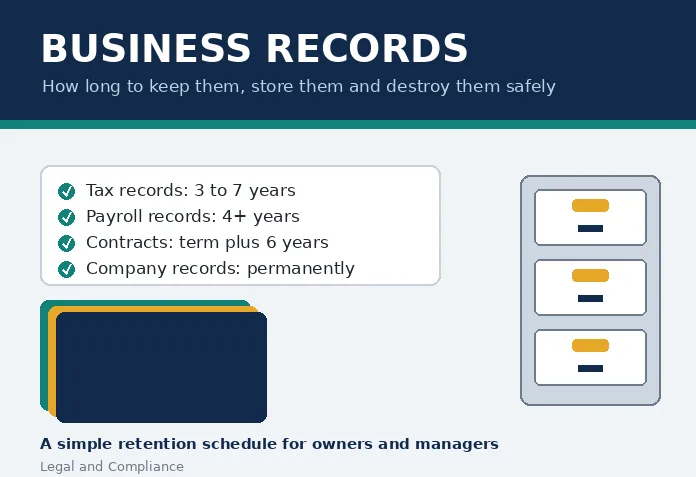
Most small businesses should keep core tax and accounting records for at least three to seven years, depending on the record type and the country they operate in. Payroll records usually sit in the middle of that range. Contracts should be kept for the life of the agreement plus several years afterwards. Founding documents, ownership records, property records, annual accounts, and filed returns should be kept permanently. The safe approach is a short written retention schedule that lists each record type, the event that starts the clock, the period, the storage location, and the destruction method, checked once a year against current guidance from your tax authority.
Why record retention matters for a small business
Records are the evidence behind almost every important claim your business makes. A tax return is only as strong as the invoices, receipts, and bank statements that support it. A pay decision is only defensible if the payroll records behind it still exist. A contract only protects you if you can produce the signed version when a dispute arises. When records are missing, the business argues from memory, and memory rarely wins.
Keeping records for too long carries its own risks. Old employee files, customer details, and financial documents contain sensitive information, and the more copies sit in email accounts, laptops, and shared drives, the greater the harm if they are lost or stolen. The other cost is confusion: staff cannot tell which copy is official, and nobody knows what can safely be deleted.
The principle behind every retention period
Almost every retention period in this guide follows one simple principle. You keep a record for as long as someone with a legitimate right to question it can still do so, plus a sensible margin. For tax records, that window is set by the period during which the tax authority can review a return or process a refund claim. For contracts, it is the period during which either side can bring a claim. For employment records, it reflects how long pay and workplace claims can still be raised.
Three practical points follow. First, the clock rarely starts on the day you create the document. It usually starts on a later event, such as the date you filed the return, the end of the accounting period, the date the tax became due, the end of employment, or the date a contract ended. Counting from the wrong event can destroy records a year or more too early. Second, periods are minimums, not targets. If a review, audit, claim, or dispute is open or expected, pause destruction for the records involved, even if the normal period has expired. Third, different rules can cover the same document at once, each with a different period. The safe period is the longest one that applies.
Tax records: how long to keep them
Tax records include filed returns, the workings behind them, sales invoices, purchase receipts, expense claims, travel logs, bank and card statements, and correspondence with the tax authority about the figures. If a document helped you arrive at a number on a return, treat it as a tax record and keep it for the full period for that return.
What the IRS guidance shows
In the United States, the Internal Revenue Service guidance on how long to keep records ties retention to the period of limitations for the return. For most returns, the IRS points to three years from the date you filed, or two years from the date you paid the tax, whichever is later, where a refund claim is involved. That period stretches to six years if income that should have been reported was left out and the amount is more than 25 percent of the gross income shown on the return, and to seven years for a loss from worthless securities or a bad debt deduction. Where no return was filed, or a fraudulent return was filed, the IRS sets no time limit at all. Property records follow their own rule: keep them until the period of limitations expires for the year you dispose of the property.
What the HMRC guidance shows
In the United Kingdom, HMRC guidance on business records for the self employed, published on GOV.UK, requires sole traders and partners to keep records for at least five years after the 31 January submission deadline for the relevant tax year. GOV.UK gives a clear example: a return for 2022 to 2023 sent online by 31 January 2024 means keeping the records until at least the end of January 2029. Limited companies keep company and accounting records for six years from the end of the financial year they relate to, and for longer where an asset is expected to last more than six years, a return was late, or HMRC has opened a compliance check. VAT records are also kept for at least six years.
Accounting and bookkeeping records
Accounting records are the day to day financial memory of the business: the general ledger, sales and purchase ledgers, journals, trial balances, management accounts, annual statements, stock records, and bank reconciliations. These records follow the same clock as the tax records they support. A practical standard is to keep core accounting records for at least six or seven years from the end of the accounting period they belong to, which covers both the IRS and HMRC examples above.
Some accounting records deserve a longer life. Annual financial statements, filed accounts, and the final year end trial balance are worth keeping permanently. They are compact, and they are the first documents a lender, buyer, or new accountant will ask for. Keep purchase invoices, financing agreements, and depreciation workings for equipment, vehicles, and property until several years after the asset is sold or scrapped, because the tax treatment of the disposal depends on records created when the asset was bought. If you close each period in a disciplined way, using a routine such as a quarterly finance close checklist, your year end records will already be complete and far easier to archive.
HR and payroll records
People records prove the business paid people correctly, taxed them correctly, and treated them fairly, and they contain some of the most sensitive personal information the business holds. Keep them securely, restrict who can see them, and destroy them promptly once every period that covers them has passed.
Payroll and employment tax records
Payroll records include pay runs, payslips, wage calculations, overtime and bonus records, tax withholding records, pension contributions, and the returns you filed for employment taxes. As an example, the IRS requires employers to keep employment tax records for at least four years after the date the tax becomes due or is paid, whichever is later. That rule is longer than the standard three year income tax period, which is why payroll should be its own line in your schedule. In the United Kingdom, payroll records that support PAYE filings are commonly kept for at least three years from the end of the tax year they relate to, while the underlying accounting records follow the longer periods described earlier. Because several clocks can run on the same file, many businesses keep core payroll records for six or seven years.
Personnel files and hiring records
Personnel files include contracts of employment, offer letters, appraisal and disciplinary records, absence records, training records, and right to work checks. A workable principle is to keep the core file for several years after employment ends, long enough to answer a pay, dismissal, or reference dispute that surfaces after the person has left. Exact periods vary widely by country and claim type, so local advice matters here. Hiring records for people you did not employ, such as unsuccessful applications and interview notes, should normally be destroyed within months, once the recruitment decision is final.
Contracts and company records
Contracts should be kept for the whole life of the agreement and then for the period during which a claim under it could still be brought. For a typical customer, supplier, or lease agreement, owners commonly keep the signed contract, amendments, and key correspondence for at least six years after the contract ends, adjusted to the local limitation period. Leases, loan agreements, and guarantees should be kept until several years after the related property or loan is fully dealt with. Never destroy a contract just because the work finished. Disputes about payment, quality, and warranties often surface long after delivery, and the signed terms are your main protection.
Company records are the permanent core of the archive. Formation documents, articles or bylaws, registers of owners, directors, and shareholders, share transfers, minutes, and records of major decisions such as borrowing and asset sales should be kept for the life of the business and passed on if the business is sold. If the business closes, these records still matter, because former owners and directors can face questions about tax and debts for years afterwards. Agree in writing who will store the archive after closure. Keep insurance policies until they expire and any claim under them is settled, and keep claims records longer where an incident could still lead to a claim.
Retention periods at a glance
The table below summarises this guide at principle level. It is a planning aid, not a legal rule, so confirm each period for your country and industry.
| Record type | Typical planning period | Clock usually starts |
|---|---|---|
| Tax returns and supporting records | 3 to 7 years, with 7 years as a common safe standard | Date the return was filed, the filing deadline, or the end of the accounting period |
| Employment tax and payroll records | At least 4 years for IRS employment tax records, often 6 to 7 years in practice | Date the tax became due or was paid, or the end of the tax year |
| Accounting records and ledgers | 6 to 7 years, annual accounts permanently | End of the accounting period they relate to |
| Personnel files | Several years after employment ends, set locally | Date employment ends |
| Contracts and leases | Life of the agreement plus about 6 years | Date the contract ends or is completed |
| Company formation and ownership records | Permanently | No destruction date while the business exists |
| Property and major asset records | Until several years after disposal | Date the asset is sold or disposed of |
Digital vs paper storage
Most tax authorities now accept digital records, and digital storage is usually the better default. Digital files can be searched, shared with your accountant without posting originals, and backed up in a way paper never can. The conditions that matter are quality and retrievability. A digital record must be a complete, legible copy of the original, stay readable for the whole period, and be producible promptly if an auditor asks. A blurry photo of half a receipt, saved under a random file name on one phone, fails all three tests.
Build simple habits around scanning. Scan both sides where the back carries information, save files in a common format such as PDF, and name them with the date, the supplier or customer, and what the document is, so a stranger could find the record years later. File into the same folder structure every time, by year and then by record type. Where your accounting software lets you attach the source document to the transaction, use that feature, because the link between the entry and the document behind it is what a reviewer wants to follow.
Paper still has a place. Keep originals where the original itself carries legal weight, such as property deeds, certain signed agreements, and incorporation documents, in a locked, dry, fire resistant location. For bulk paper, boxed archive storage is fine, provided each box is labelled with its contents and the date it may be reviewed for destruction. The test for both formats is the same: could a competent person who was not involved at the time find and read this record within one working day, five years from now?
Backups that actually protect the archive
A record you cannot retrieve has effectively been destroyed early, so backup is part of retention, not a separate IT topic. Keep the working archive in one main location, keep at least one additional copy in a different location or service, and make sure one copy would survive a fire, flood, or theft at your premises. Cloud storage with version history is a practical answer for most small businesses.
Test the backup, do not just trust it. Once or twice a year, pick a record from three or four years ago at random and restore it. If you cannot open it and match it to the entry in your accounts, your system has a gap. Also plan for software change: if you move accounting systems, export the old records in a standard format before the subscription ends, because losing access to a cancelled system is a common way businesses accidentally destroy records years too early.
Secure destruction when the period ends
Destruction is the second half of retention. When a period expires, first check that nothing has paused the clock: no open tax review, claim, dispute, or investigation, and no lender, insurer, or contract that still needs the record. Then destroy the record in a way that matches its sensitivity. Paper containing personal, payroll, or banking information should be shredded, ideally with a cross cut shredder or a confidential waste service that provides a certificate. Everyday paper with no sensitive content can be recycled normally.
Digital destruction needs more thought than pressing delete. Remove the file from the live system and from shared drives where it was copied, and note that backup copies usually disappear on the normal backup rotation rather than instantly. Keep a short destruction log: what category was destroyed, which period it covered, who approved it, and when. That small, permanent log proves destruction was a controlled decision, not carelessness.
What happens if you destroy records too early
The consequences of destroying records too early are practical before they are legal. In a tax review, missing records usually mean the authority does not have to accept your figures. Deductions can be disallowed, income can be estimated in favour of the authority, and interest and penalties can follow. In a pay dispute, missing payroll records weaken the business where the employer is expected to keep the best evidence. In a contract dispute, the side that can produce the signed agreement and the payment history starts stronger.
Even where no formal penalty applies, early destruction is expensive. Reconstructing a year from bank statements, supplier copies, and customer emails takes days and still leaves gaps. It can delay a loan application, an insurance payout, or the sale of the business. Deliberately destroying records after you know a review or dispute has started is far more serious, and can be treated as obstruction in some systems. If you receive notice of an audit or claim, stop all destruction for anything relevant.
How to build a simple retention schedule
A retention schedule is a one or two page table that turns these principles into instructions your team can follow. It needs six columns: the record type, examples of what counts, the event that starts the clock, how long you keep it, where it is stored, and how it is destroyed, plus a column for the owner of each category.
Step one: list what you actually hold
Walk through the business and list where records live: accounting software, payroll software, email inboxes, shared drives, filing cabinets, and the laptops and phones where receipts and contracts quietly accumulate. This inventory usually reveals duplicates and orphans, such as contracts that exist only in one person’s inbox. Move official records into the main archive as you find them, because a schedule cannot protect a record nobody can locate.
Step two: set a period for each category
For each category, set the period using the longest rule that applies, then round it up to a simple standard your team will remember. That is why so many small businesses land on seven years for tax, accounting, and payroll records, the life of the contract plus six years for agreements, and permanent retention for company records. Write the source of each period into the schedule, for example the IRS guidance, the HMRC guidance, or the advice of your accountant, so a future manager can see why it was chosen. If you operate in more than one country, give each country its own line.
Step three: run it on a calendar
A schedule only works if someone runs it. Add retention to the compliance rhythm you already use, such as the dates in a small business compliance calendar, and set one archive review each year, just after your year end close. At that review, file the year that has just closed, run the restore test, and identify the oldest year whose period has expired. Check it for open reviews and disputes, approve destruction in writing, destroy it securely, and record it in the log.
When to keep records for longer than the standard period
Several situations justify keeping records beyond the standard period, and your schedule should name them. Keep records longer where an asset will affect a future tax calculation, where a transaction spans more than one accounting period, where a return was filed late, or where a tax authority or auditor has opened a check. Keep them longer where a contract, lease, loan, or grant agreement requires it, because funders and lenders often set periods that outlast the tax rules, and where an incident or complaint could still lead to a claim.
Frequently asked questions
How long should a small business keep tax records?
As a principle, keep tax records until the tax authority can no longer review the return they support, plus a safety margin. In the United States, the Internal Revenue Service points to three years for most returns, six years where income was substantially understated, and seven years for bad debt claims. In the United Kingdom, HMRC expects five or six years depending on business type. Your local rule always comes first.
What happens if I destroy business records too early?
If you destroy records too early, you may be unable to prove income, expenses, or pay decisions during a tax review, audit, claim, or dispute. That can mean disallowed deductions, extra tax and interest, penalties for poor record keeping, or a weaker position in a contract or employment disagreement. You may also need to reconstruct records from banks and suppliers, which costs time and rarely gives you a complete picture.
Can I keep business records digitally instead of on paper?
In most cases, yes, provided the digital copy is complete, legible, and easy to retrieve for the whole retention period. Scan both sides where needed, keep the file in a standard format, and store it with a clear name and date so an auditor or manager can find it quickly. Some originals, such as signed deeds or certain company documents, are still worth keeping on paper as well.
How long should I keep payroll and employee records?
Keep payroll records for at least as long as the tax and employment rules in your country require, and longer where a pay claim could still be made. For example, the Internal Revenue Service requires employment tax records to be kept for at least four years after the tax becomes due or is paid. Many businesses keep core payroll records for six or seven years to cover tax, wage, and contract questions together.
Which business records should I keep permanently?
Keep the records that prove the business exists and owns what it claims to own. That usually includes formation or incorporation documents, ownership and share records, property deeds and major asset purchase records, annual accounts and filed tax returns, and board or partner decisions that affect ownership or large commitments. These records have no safe destruction date while the business is trading, and many owners keep them for the life of the business.
When is it safe to destroy old business records?
It is safe to destroy a record only when its retention period has ended, no tax review, audit, claim, dispute, or legal hold is open or expected, and no contract, lender, or insurer still needs it. Check the record against your written retention schedule, get approval from the person who owns that category, and then destroy it securely. For sensitive paper, shred it. For digital files, delete them from live systems and backups in line with your policy.
