



Originally published: Sep 25, 2023. Last updated: Oct 13, 2026.
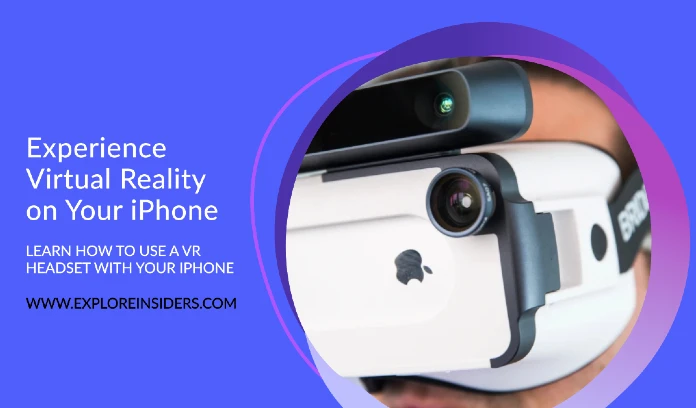
Your iPhone can be the screen inside a virtual reality headset. Slide it into a phone viewer, sometimes sold as VR goggles, and the phone’s display plus its gyroscope turn into a head-tracked VR display for 360-degree videos, simple VR apps, and casual games. This guide covers the iPhone-specific route only: which viewers actually fit modern iPhones, how to set one up correctly, the apps and streaming options that work in 2026, and the honest limitations compared with a dedicated headset.
If you want a general walkthrough that applies to any headset, read our guide on how to use a VR headset. If you are still choosing hardware across categories, start with our ultimate guide to VR headsets.
What an iPhone VR viewer actually is
A phone VR viewer is not a computer. It is a shell, usually plastic, with two lenses and a tray that holds your phone. Your iPhone does all the work: the screen shows two slightly offset images, the lenses merge them into a single 3D view, and the gyroscope tracks head rotation so the scene follows your gaze. This is called 3-degree-of-freedom (3DOF) tracking. You can look around, but you cannot lean in or walk through a scene. There is no positional tracking, no dedicated motion controllers, and no built-in VR app store. Understanding this up front sets the right expectations: phone VR is a window you look through, not a world you walk in. For how viewers fit into the wider hardware landscape, see our overview of the different types of VR headsets.
Choosing a viewer for your iPhone
Check fit before anything else. Current viewers are sized by phone screen dimension, typically between 4.5 and 7.2 inches, according to 2026 roundups from Mercury PC and The Mplsegotist. Measure your iPhone and read the tray specification before buying. Some budget viewers top out around 6.3 inches, which excludes Pro Max and Plus models, while roomier designs fit up to 7.2 inches, including the largest current iPhones. As of Oct 2026, only three phone viewers are still sold new and worth recommending; they are listed in the shortlist below. Google Cardboard remains the cheapest possible experiment, and the Cardboard app is still on the App Store, but Google no longer actively develops the platform, so treat it as disposable rather than a long-term buy.
Best VR viewers for iPhone in 2026
We did not test these viewers ourselves, and this list makes no such claim. Our process works like this: we reviewed the leading 2026 phone-VR roundups from review sites including Mercury PC and PC Guide, and kept only the viewers recommended by more than one of them. We then checked buyer feedback for each shortlisted viewer on Amazon, looking at star ratings, review counts, and the praise and complaints that come up again and again. Finally, we confirmed every viewer below is still sold new as of October 2026. Anything discontinued was dropped from the list. Prices below are approximate and change often, so treat them as a guide and check the current price before buying. Product names link to the manufacturer page where one exists.
1. DESTEK V5
Best for: First-time buyers who want the most complete phone VR kit.
The V5 is the consensus pick across 2026 phone-VR roundups: a 110-degree field of view, anti-blue-light aspheric lenses, adjustable pupil distance, touch buttons, and a Bluetooth controller in the bundle. On Amazon it holds around 4.3 to 5 out of 5 across its current listings, with hundreds bought monthly, and buyers praise the wide view, the comfortable fit, and the included controller. Two honest caveats: on iPhones the controller works in Player mode only, so plan on gaze or tap control in most apps, and some buyers report pairing trouble. Check fit before ordering: it takes phones with 4.7 to 6.8 inch screens and a maximum phone size of 163 by 83 mm, so remove a bulky case and verify a Pro Max model against those dimensions.
Key specs: Phone viewer, 110-degree field of view, anti-blue-light aspheric lenses, adjustable pupil distance, Bluetooth controller, touch buttons, fits phones 4.7 to 6.8 inch screens, 12-month warranty.
Price: Around $40 to $50 depending on the bundle and retailer. Prices change frequently, so check the current price before buying.
2. TECKNET VR Headset
Best for: Budget buyers who want a controller included at the lowest credible price.
The TECKNET is the value pick in 2026 phone-VR roundups, named best overall phone VR by Mercury PC: a 110-degree field of view, anti-blue-light lenses, adjustable gears, and a Bluetooth controller, with a roomy tray that fits phones from 4.7 to 7.2 inches, including Pro Max models. On Amazon it holds around 4.0 to 4.1 out of 5 from more than 3,300 ratings, with buyers praising comfort and value. The main complaint is controller reliability, and many owners simply use it without the remote for video. It also carries an unusually long 36-month warranty.
Key specs: Phone viewer, 110-degree field of view, anti-blue-light lenses, adjustable gears, Bluetooth controller, fits phones 4.7 to 7.2 inch screens, 268 g, 36-month warranty.
Price: Around $31 to $40 depending on the retailer. Prices change frequently, so check the current price before buying.
3. Bnext VR Headset
Best for: The cheapest possible way to try phone VR.
The Bnext is the no-frills budget viewer: a simple shell with adjustable lenses and focus adjustments, no controller, at a fraction of the price of the picks above. On Amazon it holds around 3.5 out of 5 from more than 12,000 ratings, with buyers calling it easy to use and fun for kids, while comfort and lens quality are the recurring complaints. TechGearLab rated it 3.5 out of 5 and did not recommend it over better-built rivals. Two things to know before buying: its tray fits phones with 4 to 6.3 inch screens, so larger iPhones may not fit, and the manufacturer no longer maintains its own store page, so it is sold through Amazon. Buy it only if the budget is the deciding factor.
Key specs: Phone viewer, adjustable lenses and focus, no controller, fits phones 4 to 6.3 inch screens.
Price: Around $17 to $20 on Amazon. Prices change frequently, so check the current price before buying.
Viewers to avoid
Samsung Gear VR never worked with iPhones. It ran Samsung and Oculus software on Galaxy phones only, so any old guide listing it as an iPhone option is simply wrong. The same goes for the discontinued viewers recommended in outdated articles (Homido VR, Zeiss VR One, View-Master VR, Dodocase): they are no longer sold or supported, and their companion apps are gone or abandoned. Do not pay resale prices for them.
Setting up your iPhone in a viewer
- Confirm your gyroscope works. Open any 360-degree photo or video and tilt the phone; the view should follow your movement. Without a working gyroscope, phone VR is a non-starter.
- Install your VR app first, on Wi-Fi, before the phone goes into the headset. A VR video player or the Google Cardboard app is the usual starting point.
- Turn on Do Not Disturb. A call or notification mid-session is genuinely jarring when the phone is strapped to your face.
- Remove bulky cases so the phone sits centered in the tray. An off-center phone causes eye strain within minutes.
- Center the split-screen line with the middle of the lenses, close the tray, then adjust the head straps and focus knobs until the image is sharp for both eyes.
- Control apps with gaze, the viewer’s button, or your voice. Pair a Bluetooth controller only if your specific app supports it on iOS, because iOS controller support in VR apps is limited.
Clear a few feet of space and sit down for your first sessions. For deeper setup detail that applies across headset types, see our guide on how to set up your VR headset.
VR apps that actually work on iPhone
The iPhone VR app scene in 2026 is small but functional. These are the categories that work:
- Setup and demos: the Google Cardboard app handles viewer setup, lens calibration, and demo experiences, and it still installs on current iPhones.
- VR video players: apps such as VR Virtual Reality 360 on the App Store let you play 180-degree and 360-degree videos in split-screen viewer mode, including your own footage. Trackers such as AppsHunter list several maintained VR player apps updated as recently as Oct 2026.
- Curated VR libraries: Fulldive VR bundles VR videos, photos, and games in a single app, which saves you hunting across the App Store.
- 360 video on YouTube: the app’s large 360-degree library works by moving your phone to look around; for the true headset view, open the same videos through a dedicated VR player.
One honest note: Apple’s real immersive strength on the iPhone is augmented reality through ARKit, which powers most of the immersive apps on the App Store in 2026, as 5thscape’s 2026 iPhone VR roundup points out. If AR interests you as much as VR, the iPhone is genuinely excellent at it; phone-based VR is the smaller, quieter corner of the ecosystem.
WebXR in iPhone Safari: the current reality
As of Oct 2026, Safari on iPhone and iPad does not implement the WebXR Device API. There are no immersive-vr or immersive-ar sessions in the browser, a status confirmed by 2026 browser-support references from TestMu AI and Abratabia (updated June 2026). You can still view inline 3D scenes by dragging or tilting your phone, but a true browser-based VR session will not start. The practical workarounds are native iOS apps, as covered above, or third-party apps that bridge to ARKit. Apple has announced no public timeline for bringing WebXR to iOS. Note the contrast: Safari on the Apple Vision Pro has supported WebXR since visionOS 2 arrived in 2024, so Apple’s browser VR story lives on its headset, not on the iPhone.
Streaming PC VR to your iPhone
If you own a gaming PC, you can go beyond the phone’s native apps by streaming PC-rendered VR to the iPhone in your viewer:
- iVRy: an App Store app paired with a free Steam driver that turns your iPhone into a SteamVR headset display. It supports wired USB connections for best quality and Wi-Fi for mobility, according to its App Store listing.
- VRidge-style apps: a PC server plus an iPhone client that streams the VR-rendered view from your gaming PC to the phone. Setup guides such as InAirSpace’s iPhone VR-on-PC walkthrough cover same-network pairing step by step.
What does not work: Steam Link on iPhone streams your PC’s flat 2D games, not VR content, as Apfelpatient’s Steam Link coverage confirms. Do not expect headset VR through Steam Link. For any streaming route you need a VR-capable gaming PC, both devices on the same network, and ideally the PC wired to your router. Expect some latency, so these setups suit seated experiences rather than fast competitive games. Valve’s Steam Remote Play page lists the platforms its streaming officially supports.
Phone VR vs a dedicated headset: honest limitations
Before spending money, compare what each route actually gives you:
| iPhone + viewer | Meta Quest 3 / 3S | Apple Vision Pro | |
|---|---|---|---|
| Tracking | 3DOF: head rotation only | 6DOF: move through space | 6DOF plus eye and hand tracking |
| Controllers | Gaze, tap, or viewer button; limited iOS Bluetooth support | Two motion controllers | Eyes, hands, and voice |
| Display | Your phone’s screen | Built-in display, high refresh rate | Dual micro-OLED, very high resolution |
| Ecosystem | Small iOS VR niche | Large standalone store | visionOS apps; WebXR in Safari |
| Best for | 360 video, casual experiments | Gaming, fitness, social VR | Spatial computing, media, work |
A phone viewer is a cheap window into 360-degree content. If you want real VR gaming with hand tracking, a standalone headset such as the Quest 3 is a different class of device entirely, no phone required. Apple’s own path is the Vision Pro, which launched in the US on Feb 2, 2024, starting at $3,499, according to Apple. Your iPhone still has a role there: iPhone 15 Pro and iPhone 16 models can capture spatial video for playback on the Vision Pro, as MacRumors documents. For a broader look at what VR can do once you move past a viewer, see the advantages of virtual reality.
Getting the best experience
- Start with short sessions of 10 to 15 minutes and stop if you feel queasy. Motion discomfort is normal at first.
- Sit down for early sessions and keep the play area clear of furniture and pets.
- Keep the phone charged and cool. VR apps drain batteries fast and a hot phone throttles performance.
- Wipe the viewer lenses before each session. Fingerprints and fog blur everything.
- Share the headset between people only after wiping it down; viewers sit directly against the face.
Where iPhone VR goes next
Phone-viewer VR has plateaued while dedicated headsets keep advancing. Apple’s bets are the Vision Pro and ARKit on iPhone, and WebXR in iOS Safari remains the missing piece that would unlock browser-based VR for hundreds of millions of iPhones. For the wider trajectory, read our piece on the future of virtual reality.
A phone viewer will not replace a real headset, but for the price of a budget accessory it remains the cheapest way to find out whether VR is for you, using the iPhone already in your pocket.
Frequently asked questions
Can any VR headset work with an iPhone?
No. Only phone viewers, shells with lenses that hold your phone, work with iPhones. Dedicated headsets such as the Meta Quest run their own software and do not use your phone as a display. Samsung Gear VR also never worked with iPhones; it was exclusive to Samsung Galaxy phones.
Which VR viewers fit a modern iPhone?
As of Oct 2026, current viewers such as the DESTEK V5 and generic phone viewers typically fit phones between 4.5 and 7.2 inches, which covers the iPhone 12 through 16 families. Check the tray specification carefully if you own a Pro Max or Plus model, since some cheaper viewers top out around 6.3 inches.
Does iPhone Safari support WebXR?
No. As of Oct 2026, Safari on iPhone and iPad does not implement the WebXR Device API, so browser-based immersive VR sessions cannot start. Use native iOS VR apps instead. Safari on the Apple Vision Pro has supported WebXR since visionOS 2 in 2024.
Can I play SteamVR or PC VR games on my iPhone?
Yes, with caveats. Apps like iVRy pair an iPhone app with a Steam driver to turn your phone into a SteamVR display, over USB or Wi-Fi, and VRidge-style apps stream PC VR to a phone client. You need a VR-capable gaming PC on the same network, and you should expect some latency. Steam Link on iPhone only streams flat 2D games, not VR.
Can I use a Samsung Gear VR with my iPhone?
No. The Gear VR only ever worked with Samsung Galaxy phones through Samsung and Oculus software. It was never compatible with iPhones, and old guides that list it as an iPhone option are wrong.
Is a phone viewer worth it, or should I buy a Meta Quest?
It depends on your goal. A phone viewer is the cheapest way to watch 360-degree videos and try casual VR with the iPhone you already own. For real VR gaming with motion controllers and room-scale tracking, a standalone headset such as the Meta Quest 3 is a different class of device and worth the step up. Apple’s premium alternative is the Vision Pro, which also plays spatial video captured on recent iPhones.
