



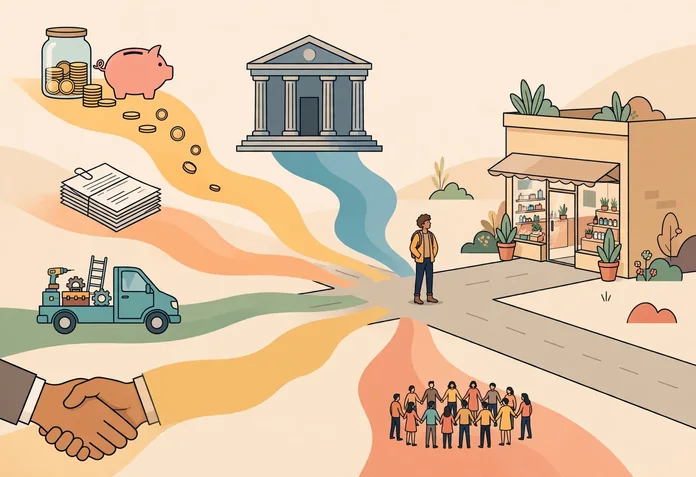
Ask a room of owners where the money for their next step will come from and the answers usually start with the source they already know: a loan, an overdraft, their own savings, an investor a friend mentioned. That order is backwards. The source is the last decision, not the first. What decides whether funding helps or hurts is the fit between the money and the job it has to do: how much is needed, how long it will be tied up, what it costs in total, what security stands behind it, and how much control changes hands. This guide works in that order, purpose first, sources second.
In short: the main sources of finance
- Internal funds: the owner’s own capital, retained profits and selling an unused asset; best for first steps and smaller needs, with no repayment and no loss of control.
- Debt: bank term loans, overdrafts and lines of credit, equipment finance and leasing, supplier credit and invoice finance; best when the need and the repayment period are matched.
- Equity: angel investors, venture capital and equity crowdfunding; best for growth that cannot carry fixed repayments from day one, paid for with a share of ownership.
- Crowdfunding: reward and donation campaigns; best for launching a product with an audience willing to pay in advance.
- Grants: restricted public or charitable funding; useful only where the business genuinely fits the eligibility rules, and never the only leg of a plan.
Start with why: the reason picks the source
The People Also Asked version of this topic begins with the reasons businesses need finance, and that is the right place to start, because each reason points at a different kind of money. Starting costs are one-off spending before the first sale: registration, equipment, initial stock, a deposit on premises. The money is spent once but has to be found before any revenue exists, which is why new businesses lean so heavily on the owner’s own funds. Working capital is the everyday gap between paying out and being paid: wages, rent and suppliers fall due on their dates, while customers pay on theirs. Working capital needs are usually short and repeating, and they rise and fall with trading rather than sitting still.
Equipment and premises are long-life purchases. A machine or a fit out will serve the business for years, so it makes sense for the funding to be spread over years as well rather than squeezed out of one season of cash flow. Growth spending, a second location, a larger team, a new product line, is different again: the return arrives later and is less certain, which is why growth is the reason most likely to involve investors or a carefully staged mix of sources. Finally, refinancing and recovery: replacing expensive or badly matched borrowing with something sustainable, or funding a turnaround. Refinancing can be sensible housekeeping, but it deserves the hardest look of all, because new money used to cover old losses without fixing the losses only moves the problem.
Two mistakes follow from skipping this step. The first is borrowing long for something short: a five year loan taken to cover one season of slow payments is still being repaid long after the gap it filled has closed, and the repayments compete with the next season. The second is funding something long from something short: an owner who buys a long-life asset from an overdraft has created a permanent debt on a facility the provider can reduce or withdraw, and every month after that is a negotiation. Naming the reason first prevents both, because the reason carries the timescale, and the timescale is what the source has to match.
Four tests to run before comparing any sources
Before looking at individual sources, settle four questions. How much, exactly? A costed figure, built from quotes and a realistic allowance for the costs around the main purchase, not a round number that felt right. Funders can tell the difference, and so can your bank balance six months later. For how long? The period the money will be working before the need ends or the asset has paid for itself. What risk is acceptable? Some sources ask for security over business assets, and some ask the owner to guarantee repayment personally. Those are real commitments that survive the business decision that created them, and they should be understood in full before anything is signed.
How much control will you share? Debt leaves ownership untouched but imposes repayments and conditions. Equity shares ownership and usually brings the investor into decisions. Neither is automatically better; they are different prices for the same money. The U.S. Small Business Administration guide to funding a business makes the same point from the funder’s side: how a business chooses to fund itself shapes how it is structured and run afterwards. That is worth pausing on. Choosing a source is not just raising cash; it is choosing the obligations, reporting and relationships the business will live with while the money is repaid or the investor is involved.
Internal sources: the money already inside the business
Internal finance needs no application and no approval, which is why it is usually the first source used and often the first exhausted. Its limit is simple: the amounts are finite, and using them means the business gives up the cushion they were providing.
The owner’s own capital
Money the owner puts in, from savings or personal assets, is the foundation of most small business funding. It carries no interest, no repayment date and no outside approval, and it signals commitment: lenders and investors both read an owner’s contribution as evidence that the person who knows the business best is sharing the risk. The limits are equally clear. Personal funds are not unlimited, money put into the business is at risk in the business, and mixing personal and business money without clean records creates tax and accounting confusion later. Put the contribution in deliberately, record it properly, and keep the boundary between the owner’s finances and the business’s finances visible from day one.
Retained profits
Profit the business has earned and kept, rather than paid out, is the healthiest growth funding there is: it arrives without interest, fees or dilution, and it proves the model works. It is also the slowest source to build and the easiest to overestimate. Retained profit exists only if the profit was real and the cash stayed in the business; a profitable year whose cash is locked in unpaid invoices has not produced spendable funds. Businesses that fund growth this way tend to do it in stages, reinvesting each period’s surplus into the next step, which is slower than borrowing but leaves no repayment competing with the growth it paid for. Our guide to how to make a business profitable covers the margin and pricing work that creates this surplus in the first place.
Selling an unused asset
Most established businesses own something they no longer use: surplus equipment, a vehicle, stock lines that stopped moving, even space that could be sublet where the lease allows. Selling an unused asset converts a dormant item into funding with no repayment and no new obligation, and it often improves the numbers a funder sees, because the balance sheet stops carrying dead weight. The discipline is honesty about what is genuinely unused. Selling something the business still needs and then hiring or replacing it is not funding; it is a more expensive way of owning the same asset. Treat this as a one-time source, because it is one: once sold, the asset cannot fund the next step too.
Debt sources: borrowed money that must be repaid
Debt is money lent for a period, repaid with interest and fees, without the lender taking ownership. The owner keeps control, and in exchange accepts a fixed obligation: repayments fall due whether trading is good or bad. Each type of debt below fits a different job, and most debt problems in small businesses are really fit problems.
Bank term loans
A term loan is a fixed amount borrowed and repaid in instalments over an agreed period. It suits defined, longer needs: buying equipment, fitting out premises, acquiring another business, or funding a growth step with a predictable cost. The lender assesses the business’s trading history, accounts and forecasts, the purpose of the loan, and what security is available; in the United States, the SBA describes the preparation in practical terms, a business plan, an expense sheet and financial projections, and advises owners to compare offers rather than accept the first one. A loan guaranteed under an SBA programme is still a loan from a lender, with the SBA standing behind part of it, which can help an applicant a lender considers risky. The failure mode to avoid is using a term loan for everyday running costs: the repayments are fixed, the spending was not, and the business ends up servicing a loan for money that has already gone.
Overdrafts and lines of credit
An overdraft or revolving line lets the business draw money as needed up to a limit and repay it as cash comes in, paying interest on what is used. Properly used, it is the right shape for working capital: the gap between paying suppliers and being paid is short and repeating, and the facility flexes with it. The risks are in the terms. Overdrafts are commonly repayable on demand, which means the provider can reduce or withdraw the facility, and a business that treats the limit as permanent capital is exposed the moment that happens. The classic failure mode is the permanent overdraft: the balance never returns to credit, ordinary costs are quietly being carried by the bank, and the facility that was meant to smooth timing has become structural debt that needs a different, deliberate solution.
Equipment finance and leasing
Equipment finance and leasing spread the cost of a specific asset over its working life. In a finance arrangement the business ends up owning the asset; in a lease it pays for use, with ownership depending on the agreement. Either way, the asset itself is central to the provider’s decision, which can make this route available where general borrowing is harder, and the repayments roughly match the period the asset earns its keep. Read the agreement for the total payable over the full term, what happens at the end of it, maintenance and return conditions on leased equipment, and what an early exit costs. The failure mode is financing short-life equipment over a long term, so the business is still paying for equipment it has already replaced.
Supplier or trade credit
Supplier credit is the funding built into ordinary trading terms: the supplier delivers now, and the business pays on the agreed date. It is often the largest short term source a trading business uses, and it costs nothing explicit when terms are simply used as agreed. It is still a commitment, not a favour. Stretching payments beyond agreed terms without discussion damages the relationship the business depends on, can trigger tighter terms or stopped supply, and in some jurisdictions late payment carries legal consequences for the payer. The sustainable version of supplier credit is negotiated, not taken: agree longer terms openly where the supplier can offer them, keep payment dates reliable, and treat a key supplier’s terms as part of the funding structure rather than slack to absorb every cash problem.
Invoice finance and factoring
Invoice finance releases money tied up in unpaid invoices: a provider advances funds against invoices the business has already issued, and the balance follows when the customer pays, minus the provider’s charges. Factoring goes further and hands the collection of those invoices to the provider as well. It suits businesses that sell to other businesses on credit terms and wait weeks to be paid, because the funding grows with sales rather than sitting at a fixed limit. The questions that decide whether it fits are the total charges over the life of an invoice, what happens if a customer pays late or not at all, and how the arrangement ends. It is a substantial product with its own contract traps, covered at survey level here on purpose: the detail belongs in a dedicated guide, and an owner considering it should read the contract terms with the same care as a loan agreement.
Equity funding does not have to be repaid on a schedule, which makes it the natural fit for spending whose return is distant or uncertain. The price is ownership: the investor takes a share of the business, a share of future profits, and usually a voice in major decisions. The SBA’s funding guidance is blunt about venture capital on this point, noting that investors typically expect an ownership share and an active role, often including a seat on the board.
Angel investors
Angels are individuals investing their own money, usually in early stage businesses, often with experience in the same sector. What they buy is a share of a business they believe can grow well beyond its current size; what they bring, at their best, is contacts, credibility and hard won pattern recognition alongside the money. Angel funding suits a business with a growth story that debt cannot sensibly fund because there is not yet enough trading history or predictable cash flow to service repayments. The owner’s work is in the terms: how much of the business is given up, at what valuation, with what rights and expectations attached. An angel relationship lasts for years, so the fit between owner and investor matters as much as the amount.
Venture capital
Venture capital is professional investment into businesses expected to grow very fast and very large. It is worth stating plainly, because the term is used loosely: venture capital suits only a minority of businesses, those with a model that can scale far beyond the local or the incremental, and investors who need that scale to make their returns. For most small businesses it is not a realistic or desirable source, and that is not a failure. A profitable business growing steadily is often better served by retained profits and well matched debt than by funding that demands exceptional growth on a timetable. Where venture capital does fit, expect rigorous due diligence on the team, the market and the numbers, investment in rounds tied to milestones, and an investor actively involved in strategy.
Equity crowdfunding
Equity crowdfunding raises investment from a large number of smaller investors through a platform, in exchange for shares. It can work for a business with a loyal customer base or a story a crowd can understand, because the campaign itself is also marketing. The obligations are real, though: the business takes on many small shareholders, platform and legal requirements apply to how shares are offered (the rules differ by country and are regulated in many of them), and reporting to investors continues after the campaign closes. The structure of the business matters here more than anywhere else in this guide, because how shares can be issued and held depends on it; our explainer on choosing between an LLC, a corporation and a sole proprietorship covers the groundwork an owner needs before offering anyone a share of anything.
Crowdfunding beyond equity: reward and donation campaigns
Reward crowdfunding is customer funding: backers pay in advance and receive the product, or a perk, when it is ready. The SBA describes this model accurately, backers generally receive a gift or the product itself rather than a share or a financial return. For a product launch it is an elegant source, because it funds production with money from the people who want the product, and a successful campaign is evidence of demand a lender or investor will respect. The obligations are the delivery itself: platform fees come off the amount raised, the campaign that misses its target may return everything, and backers who paid for a product expect it on the promised schedule. Price the campaign to cover production, fees, packaging and the delays that happen in every first production run. Donation crowdfunding, where supporters give without expecting a product, suits community and creative projects more than commercial funding plans, and no business should build its financing on goodwill it cannot schedule.
Grants: restricted money, worth having when you truly qualify
A grant is funding that does not have to be repaid, given for a defined purpose by a government body, a foundation or another organisation. That definition attracts more misunderstanding than any other in this guide. Grants are competitive, restricted to specified uses, often require the business to match part of the cost from its own funds, and sometimes pay out only after the spending has happened and been evidenced. Eligibility is set by the funder, by place, sector, size and purpose, and schemes open and close, so availability is local and time limited by nature. In the United States, for example, the SBA states plainly that it does not provide grants for starting and expanding a business; its grant activity is limited to areas such as scientific research programmes, exporting support delivered through state entities, and grants to organisations that support entrepreneurs. Other countries and regions run different schemes, which is exactly the point: check the official finder or programme pages for your own place and sector, on the day you plan, rather than relying on a list article that may describe a closed scheme. Used that way, a grant is a genuine bonus that reduces what must be found elsewhere. Used as the plan’s only leg, it is a delay dressed as a strategy, and anyone offering to sell access to guaranteed grant money is selling something that does not exist.
The sources compared
The table below compresses the comparisons above. Cost is described by type rather than by rates, because rates and fees vary by provider, applicant and date, and a figure printed here would be wrong for most readers by the time it mattered.
| Source | Best fit purpose | Repayment or return expected | Security | Effect on control | Main risk |
|---|---|---|---|---|---|
| Owner’s own capital | First steps, gaps other funders will not cover | None owed | None, but personal money is at risk in the business | Full control kept | The owner’s personal cushion is gone |
| Retained profits | Staged growth funded by trading | None owed | None | Full control kept | Slow to build, and can be spent only once |
| Selling an unused asset | A one-off need in an established business | None owed | None | Full control kept | One-time only; harmful if the asset is still needed |
| Bank term loan | Defined, longer needs: equipment, premises, acquisition | Fixed instalments with interest and fees | Often over business assets; guarantees possible | Ownership kept; conditions apply | Fixed repayments continue in bad trading |
| Overdraft or line of credit | Short, repeating working capital gaps | Interest on what is drawn, repaid as cash arrives | Varies; facility usually repayable on demand | Ownership kept | Becomes permanent, or is reduced when most needed |
| Equipment finance or leasing | A specific long-life asset | Payments spread over the asset’s working life | The asset itself | Ownership kept, or use only under a lease | Paying for equipment beyond its useful life |
| Supplier credit | Stock and inputs bought on agreed terms | Payment on the agreed date | None formal; the relationship is the security | Ownership kept | Stretched terms damage supply and terms tighten |
| Invoice finance | Cash locked in invoices owed by business customers | Advance repaid from customer payments, minus charges | The invoices themselves | Ownership kept; provider may handle collections | Total charges grow when customers pay slowly |
| Angel investment | Early growth debt cannot fund | A share of ownership and future profits | None; the share is the price | Shared with the investor | Terms and valuation set the relationship for years |
| Venture capital | Exceptional, fast scaling growth | A significant ownership share and an exit return | None; governance rights instead | Substantially shared; board involvement typical | Growth demands most businesses cannot or should not meet |
| Equity crowdfunding | A launch or growth step with a crowd behind it | Small shares held by many investors | None | Shared with many small shareholders | Platform, legal and reporting obligations continue |
| Reward crowdfunding | Funding a product launch in advance | The product or perk, delivered as promised | None | Full control kept | Underpriced campaigns lose money on delivery |
| Grants | A defined purpose the funder supports | None, if the conditions are met | None; evidence of spending instead | Full control kept, within the grant’s conditions | Competitive, restricted, and often paid after spending |
Matching rules: the short version of this whole guide
Match short needs to short sources. A gap that closes in weeks should be funded by something that ends in weeks: an overdraft used and repaid, supplier terms used as agreed, invoice finance against money already owed. Match long-life assets to longer terms. Equipment and premises earn over years, so their funding should be repaid over years, not squeezed from a single season. Match uncertain growth to patient money. Spending whose return is distant or doubtful sits badly under fixed repayments that start immediately; that is the territory of retained profits staged over time, or equity that shares the risk. Never use new debt to disguise a model that loses money on every sale. Borrowing can fund timing and growth; it cannot fix a price that does not cover costs, and each loan taken to try makes the eventual reckoning larger.
The last rule is about sequence. Owners often combine sources, and the order matters: internal funds first, because they are cheapest and they evidence commitment; matched debt or product funding for the defined need; equity where the growth justifies sharing ownership; a grant as a contribution where genuinely eligible, never as the foundation. Our rolling 13-week cash-flow forecast guide is the tool that tests the sequence, because it shows week by week whether the chosen repayments actually fit the cash the business expects to have.
Application readiness: what a funder will ask for
Whatever the source, preparation is read as evidence. A funder assessing an application typically wants the amount and the purpose stated specifically, recent accounts, bank records, and a forecast that shows how the business runs with the new obligation included. For a loan, lenders go further and judge the application against a set of lending criteria, character, capacity, capital, collateral and conditions, which is a subject in its own right; the practical point here is that every one of those judgements is made from documents the business either has in order or does not. The balance sheet is one of the statements those judgements rest on, and our guide to why a balance sheet is important for a small business explains what a reader takes from it.
Two habits decide whether that preparation is easy or painful. The first is record keeping: our guide to why keeping records is essential for your business sets out what to keep and why, and funders are one of the strongest reasons. The second is knowing exactly what your bookkeeping already produces, because lenders ask for reports that a well kept system generates in minutes and a neglected one takes weeks to reconstruct; if you are unsure where that boundary sits, our explainer on what bookkeepers do for a small business maps the work. Prepare the pack before you need it: the businesses that raise money fastest are usually the ones whose numbers were already in order when the opportunity appeared.
Red flags to walk away from
Some warning signs should stop an application or an offer in its tracks. Guaranteed approval claims. No legitimate funder can promise approval before assessing the business; the promise is the marketing of a provider whose money will be the most expensive on the table. Pressure to sign quickly. Funding that cannot survive a night of reading and a set of questions is funding designed not to be understood. Unclear total cost. If the interest, fees, charges and exit costs cannot be added up from the documents in front of you, the comparison you are being offered is not the comparison that matters. Security and guarantees you have not understood. An owner who signs a personal guarantee without independent advice has taken a business risk home with them, possibly for years. And stacking several short term debts, each taken to service the last, is the pattern that turns a funding problem into a solvency problem. None of this is an argument against borrowing or taking investment. It is an argument for choosing the source the way this guide started: by the job, the term, the total cost and the control it changes, with the paperwork read properly. This article is general information about how business funding works, not financial advice for any specific business; for a decision of any size, a qualified local accountant or adviser who can see your actual numbers is the right next step.
Sources used for this article
- U.S. Small Business Administration, Fund your business: https://legacy.sba.gov/business-guide/plan-your-business/fund-your-business
- U.S. Small Business Administration, Grants: https://www.sba.gov/loans/additional-funding-opportunities/grants/
Frequently asked questions
What are the main sources of finance for a small business?
The main sources are the owner’s own capital, retained profits and selling an unused asset; debt in the form of bank term loans, overdrafts and lines of credit, equipment finance and leasing, supplier credit and invoice finance; outside equity from angel investors, venture capital and equity crowdfunding; reward or donation crowdfunding; and grants where the business is genuinely eligible.
What is the difference between debt and equity finance?
Debt is borrowed money that must be repaid, usually with interest and fees, and the lender does not own part of the business. Equity is money invested in exchange for a share of ownership: it does not have to be repaid on a schedule, but the owner gives up part of the business and a say in how it is run.
Which source suits a startup with no trading history?
A startup with no trading history usually starts with the owner’s own capital, sometimes alongside reward crowdfunding or a grant it is genuinely eligible for. Debt is harder without a track record, because lenders assess repayment from trading history and forecasts. Some startups bring in an angel investor who is backing the founder and the idea as much as the numbers.
Is retained profit a source of finance?
Yes. Profit the business has earned and kept, rather than paid out to the owner, is an internal source of finance. It can fund stock, equipment or growth without interest or repayment, but it can only be used once, and a young business that has not yet built up profits does not have it to use.
Which funding fits a short-term cash gap?
A short term cash gap fits a short term source: an overdraft or line of credit used briefly and repaid, supplier terms used as agreed, or invoice finance against money customers already owe. The mismatch to avoid is a long term loan or permanent borrowing for a gap that closes in weeks.
What should an owner prepare before applying for finance?
Prepare the amount and the purpose in specific terms, recent accounts and bank records, a cash flow forecast that shows how any repayment fits, evidence of the owner’s own contribution, and clean, complete records. Funders judge the quality of the preparation as evidence of how the business is run, so accuracy matters more than polish.
