



Originally published: Dec 17, 2021. Last updated: Oct 17, 2026.
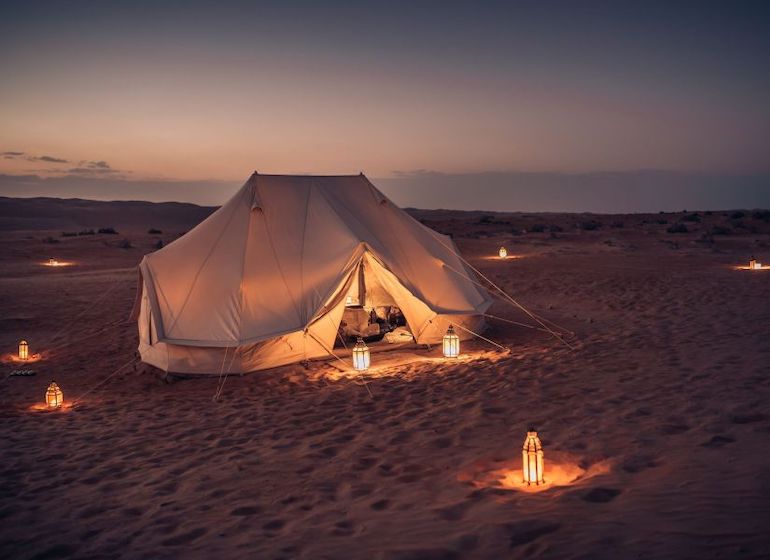
There are few experiences in the United Arab Emirates as quietly magical as a night in the desert. When the sun drops behind the dunes, the heat of the day melts away, the sky turns from amber to indigo, and the stars come out with a clarity you simply never see in the city. For residents, desert camping is a beloved winter ritual. For visitors, it is one of the most authentic ways to experience the Arabian landscape that existed long before the skyscrapers.
Dubai is surrounded by desert on almost every side, which means you are never more than an hour from a campsite. Some spots are wild and free, where you pitch your own tent under the open sky. Others are polished glamping experiences with proper beds, chef-prepared dinners, and astronomers pointing out constellations. This guide covers the best of both worlds, along with the current rules, permits, costs, and safety practices you need for the 2026 camping season.
Why Dubai Is Made for Desert Camping
Dubai has one of the most camping-friendly climates in the world for about half the year. From October to April, daytime temperatures sit in a comfortable range and nights are cool enough to need a light jacket. Unlike wetter destinations, rain is rare, so a tent or even a simple sleeping bag under the stars is often all the shelter you need. The desert around the city is vast, accessible, and varied: red dunes in the south, gravel plains in the east, mountain wadis in Hatta, and beaches in the northern emirates.
What makes camping here special is the contrast. You can spend the afternoon at a shopping mall or on Sheikh Zayed Road and, within 45 minutes, be sitting beside a campfire with nothing around you but sand and silence. Few major cities in the world offer that kind of escape so close to downtown.
The official winter camping season runs from late October to the end of April. During these months, the authorities designate special temporary camping zones, and temperatures are at their most pleasant. December, January, and February are the peak months, when nights can dip to around 10 to 15 degrees Celsius in the open desert, cool enough for a proper campfire but rarely cold enough to be uncomfortable in a good sleeping bag.
Dubai’s Winter Camping Permits and Rules
If you plan to set up a long-stay seasonal camp in Dubai, you need a permit from Dubai Municipality. The municipality opens temporary winter camp plots in the Al Awir area each season, and these permits are the formal route for anyone who wants their own semi-permanent desert camp for the winter months.
Applications for the 2025 to 2026 season opened on 21 October 2025 through the Dubai Now app and the dedicated website wintercamp.dm.gov.ae, according to the MotorCar UAE winter camping guide. Here are the key terms:
- Fee: 44 fils per square metre per week, for a maximum plot of 400 square metres per camp.
- Duration: minimum three months, maximum six months.
- Season: the season runs from 1 November to the end of April.
- Deposit: applicants typically also pay a refundable security deposit, commonly reported between AED 2,000 and AED 5,000, covering cleaning, damage, and any breaches of camp rules.
- Use: permits are issued for family use. Commercial use, hotels, and companies are not covered, and renting the plot to unrelated groups is not allowed.
The rules attached to the permit are practical rather than onerous. Camps must be enclosed with a temporary fence and removed entirely when the permit ends. A fire extinguisher is required at the camp, fireworks are banned, and open flames must be handled safely. Cycling inside the camping area is limited to 20 km/h, loudspeakers and flashlights used carelessly are discouraged, and the site must be kept clean, as reported by the Khaleej Journal and Emarat Directory.
For a single overnight trip, which is what most visitors and weekend campers do, you generally do not need this seasonal permit. You simply choose a location where informal camping is tolerated, follow the local rules, and leave no trace. But the permit system matters because it shows how seriously Dubai takes orderly, safe camping: this is not a free-for-all, and fines for littering or damaging the desert environment can be severe.
Best Places for Overnight Camping in Dubai and Beyond
Here are the standout locations, each with what makes it special, how to get there, what facilities to expect, and which months suit it best.
1. Al Qudra and the Al Marmoom Desert
Al Qudra is the classic Dubai desert camping spot and the easiest to reach, roughly 30 minutes by car from the Mall of the Emirates. It sits inside the Al Marmoom Desert Conservation Reserve, a protected area of desert, lakes, and wildlife that makes the setting feel far wilder than its distance from the city suggests.
The lakes attract flamingos, swans, and other waterbirds, especially in the cooler months, and if you wake at dawn you may spot wild camels wandering across the dunes. The 86 kilometre Al Qudra cycling track runs alongside the lakes and is one of the most popular cycling routes in the country. Nearby Love Lake, a pair of interlocking heart-shaped man-made lakes, is a favourite photo stop.
The important rule: camping, bonfires, and barbecues directly at the Al Qudra lakes have been banned since December 2017, with fines of AED 500 per violation. This ban protects the wildlife and the lakes themselves. However, camping in the wider Al Qudra desert area is still permitted, and barbecues are allowed if you use a raised barbecue stand rather than an open fire on the ground.
Getting there: drive down Al Qudra Road (D63) from the city. A regular sedan can reach the main camping areas; you do not need a 4×4 for the popular spots near the road, though deeper into the dunes a 4×4 is essential. Facilities: none, this is wild camping, so bring everything including water. Best months: October to April.
2. Hatta Dome Park
For campers who want the desert night without giving up a proper bed, Hatta Dome Park is the standout glamping option. Launched in April 2021 by Dubai Holding, the park sits against the dramatic Hajar Mountains in the Hatta exclave, about 90 minutes from central Dubai.
The accommodation is the attraction: 15 dome-shaped tents with panoramic windows that frame the mountains like a painting. Each dome comfortably fits two adults and two children, blending the romance of sleeping under the stars with hotel-grade bedding, climate control, and private facilities. The mountain setting also makes Hatta noticeably cooler than the open desert, and the area offers kayaking at Hatta Dam, mountain biking trails, and heritage village visits by day.
Getting there: drive the Dubai to Hatta road (E44). The route is fully paved and suitable for any car. Facilities: full glamping facilities, on-site dining options, and activities bookable through the resort. Booking: reservations are made online, and the domes sell out quickly on winter weekends, so book well ahead. Best months: October to April, when Hatta’s mountain air is at its finest.
3. Mleiha National Park, Sharjah
Just over an hour’s drive from Dubai, Mleiha National Park in Sharjah offers the most complete desert night experience in the northern emirates. The park sits at the base of the Al Faya mountain range in a landscape of red dunes and fossil-rich rock formations, and it layers 210,000 years of human history over the natural setting, with Stone Age caves, Bronze Age tombs, and pre-Islamic sites scattered across the area.
Mleiha’s glamping operation is a highlight. According to Family Travel Middle East, standard tents sleeping two adults start from around AED 1,295, family tents for two adults and two children from around AED 1,550, and the whole five-tent site can be booked privately from around AED 5,200. Guests are transported to the overnight site by Mercedes Unimog, enjoy a stargazing session with an astronomer, dine under the stars with a resident chef or bring their own barbecue, and are driven to a sunrise viewpoint before a picnic breakfast.
The park launched a new season of glamping, stargazing, and desert adventures in December 2025, with a calendar of celestial events running through 2026, as announced in a PR Newswire release and covered by Gulf Today. Because Mleiha is far from city lights, the night sky here is among the darkest accessible from Dubai, making it arguably the best stargazing campsite within easy reach of the city.
Getting there: take the Sharjah to Kalba road toward Mleiha; the archaeological centre is well signposted. Facilities: glamping tents with shared or ensuite bathrooms depending on the package, plus the archaeological centre, museum, and guided tours. Best months: November to March.
4. Liwa and Moreeb Dune, Abu Dhabi
For experienced desert campers, nothing compares to Liwa. On the northern edge of the Rub’ al Khali, the Empty Quarter, the dunes here are on a different scale entirely. Moreeb Dune, the tallest dune in the UAE at around 300 metres with a slipface approaching 50 degrees, is the centrepiece, and the surrounding dune fields stretch to the horizon in every direction.
This is serious desert. A 4×4 with proper recovery gear is mandatory, and you should travel in a convoy, carry abundant water, and have a satellite communicator or at minimum a fully charged phone with an offline map. The reward is total solitude: on a weeknight in January you may not see another camp for kilometres. The Liwa area also hosts the annual Liwa International Festival, usually around the new year, with dune motorsports, camel racing, and cultural events.
Getting there: about three hours from Dubai via the E11 and E65 toward Madinat Zayed. Facilities: none in the dunes; the town of Madinat Zayed has fuel, supplies, and hotels. Best months: November to February. Note: not suitable for beginners or two-wheel-drive vehicles.
5. Jebel Jais, Ras Al Khaimah
Jebel Jais is the tallest peak in the UAE, and its mountain campsites offer something the desert cannot: genuinely cool air. Even in the shoulder seasons, nighttime temperatures on the mountain are several degrees lower than in Dubai, and the views across the Hajar range at sunrise are spectacular.
The mountain is also an adventure hub. It is home to the Jebel Jais Flight, one of the world’s longest ziplines, plus via ferrata climbing routes, hiking trails, and viewing deck parks. Camping here pairs naturally with a day of mountain activities, and several organised camping experiences operate on the mountain during the winter season.
Getting there: about two hours from Dubai via Emirates Road toward Ras Al Khaimah, then the well-paved mountain road to the summit area. Facilities: viewing deck parks have basic amenities; organised camps provide equipment. Best months: October to April, with December to February the coolest.
6. Fujairah Coast
The only emirate on the UAE’s eastern coast, Fujairah offers a different kind of overnight escape: mountains on one side, the Gulf of Oman on the other. Beach camping here comes with snorkelling over coral reefs, dramatic mountain panoramas, and some of the quietest shorelines in the country. The Dibba and Al Aqah areas are popular bases, and the drive from Dubai takes you through spectacular mountain passes.
Beach camping in Fujairah is generally informal. Choose established spots, avoid camping too close to the waterline, check tide conditions, and confirm that the specific beach you choose permits overnight stays, as some hotel-adjacent beaches do not.
Getting there: about 90 minutes to two hours from Dubai via the Sharjah to Kalba road or the Emirates Road. Facilities: limited at wild beaches; nearby towns have supplies. Best months: October to April.
7. Umm Al Quwain Beach
Umm Al Quwain’s coastline, particularly around Khor Al Beidah, is a favourite for family beach camping. The shallow lagoon waters are calm, the sunsets are superb, and the area is known for flamingos and other wading birds, so bring binoculars. Old fishing villages nearby add a touch of heritage to the trip.
As with any beach camp, pitch above the high-tide line and keep well back from the water at night. The emirate’s beaches are quieter than Dubai’s, which is precisely the appeal: on a winter weeknight you can have a long stretch of sand effectively to yourself.
Getting there: about an hour from Dubai via Emirates Road. Facilities: minimal; bring all supplies. Best months: October to April.
When to Go: Seasons and Temperatures
Timing is everything for desert camping in the UAE. The table below summarises what to expect across the year.
| Period | Daytime | Night-time | Verdict |
|---|---|---|---|
| October | 30 to 35°C | 20 to 24°C | Season opening; warm but workable |
| November to February | 24 to 30°C | 10 to 18°C | Peak season; ideal camping weather |
| March to April | 28 to 35°C | 18 to 24°C | Still good; season tail end |
| May to September | 40 to 50°C | 28 to 35°C | Avoid; dangerously hot |
Within the peak season, January and February offer the coolest nights, which many campers prefer, while November and March give slightly warmer evenings that suit families with small children. Whatever the month, desert temperatures swing sharply between day and night, so pack layers even when the afternoon feels like summer.
What Desert Camping Costs
Costs vary enormously between wild camping and glamping, as the table below shows. Wild camping itself is free; you pay for gear, food, and fuel.
| Style | Typical cost per night | What you get |
|---|---|---|
| Wild desert camping | Free (plus your own gear and food) | Total freedom; no facilities |
| Seasonal Al Awir permit | 44 fils per sqm per week (max 400 sqm), plus deposit | Your own fenced plot for 3 to 6 months |
| Hatta Dome Park | Mid-range glamping rates | Dome tent, mountain views, resort facilities |
| Mleiha glamping | From about AED 1,295 for two adults | Unimog transfer, stargazing, dinner, sunrise viewpoint |
| Organised desert safari overnight | AED 300 to 800 per person | Dune bashing, dinner, entertainment, bedding |
If you are new to camping, an organised overnight desert safari is the simplest entry point: transport, food, and equipment are handled for you. If you want independence, a basic wild-camping setup, tent, sleeping bags, cooler, and camp chairs, can be assembled affordably from outdoor retailers in Dubai and reused for years. For more ideas on what to bring, see our family camping essentials checklist.
Desert Camping Safety Checklist
The desert is beautiful but unforgiving of poor preparation. Run through this checklist before every trip.
- Water: carry far more than you think you need, at least 5 litres per person per day, plus extra for cooking and washing. There are no taps in the dunes.
- Warm layers: desert nights in January can drop near 10°C. Pack a fleece or jacket even if the afternoon is warm.
- Fire safety: use a raised fire pit or barbecue stand, never an open fire directly on the sand near vegetation. Keep a fire extinguisher or a large water container beside the fire, and make sure the fire is fully out before sleep.
- Litter: take every scrap of rubbish home with you. Federal littering and environmental fines in the UAE can reach tens of thousands of dirhams, and the desert’s fragile ecosystem recovers slowly from damage.
- Wildlife: the desert is home to camels, oryx, foxes, and occasionally snakes and scorpions. Shake out shoes in the morning, zip tents closed, and never feed wild animals.
- Navigation: download offline maps before you leave the city. Mobile signal is patchy in deep desert areas. Share your planned location and return time with someone who is not on the trip.
- Vehicle: for dune areas, a 4×4 is essential. Reduce tyre pressure for soft sand, carry a tow rope and a shovel, and never drive into dunes alone.
- First aid: pack a basic kit including sunburn treatment, antihistamines, and any personal medication. The nearest clinic can be a long drive away.
- Weather: check the forecast. Winter shamal winds can whip up dust storms that make camping miserable and driving hazardous.
Camping with children or as a couple celebrating something special calls for a little extra planning. Our guides to places to visit in Dubai with family and how honeymooners can make overnight camping memorable have ideas worth borrowing.
Frequently Asked Questions
Do I need a permit to camp overnight in the Dubai desert?
For a single overnight trip in areas where informal camping is tolerated, such as the wider Al Qudra desert, you do not need the seasonal permit. The Dubai Municipality seasonal permit, at 44 fils per square metre per week for plots up to 400 square metres, is for long-stay winter camps in the designated Al Awir zones, with a minimum term of three months. Always check current rules before you go, as regulations are updated each season.
Can I camp at Al Qudra Lakes?
You can camp in the wider Al Qudra desert area, but camping, bonfires, and barbecues directly at the Al Qudra lakes have been banned since December 2017, with fines of AED 500 per violation. The ban protects the lakes and their wildlife, including flamingos and swans. If you barbecue elsewhere in the area, use a raised stand rather than an open fire on the ground.
What is the best month for desert camping in Dubai?
December, January, and February are the peak months, with daytime temperatures around 24 to 30 degrees Celsius and nights between 10 and 18 degrees. These months give you the classic desert camping experience: warm days, cool nights, and clear starry skies. November and March are also excellent and slightly quieter.
Is desert camping in Dubai safe for families?
Yes, provided you prepare properly. Choose well-known areas like Al Qudra or an organised glamping site such as Hatta Dome Park or Mleiha for your first trips, carry plenty of water, pack warm layers for the night, and keep children away from campfires. For deep desert areas like Liwa, go with experienced companions and proper 4×4 vehicles. Sharing your location with someone back in the city is always wise.
How much does it cost to camp in the Dubai desert?
Wild camping is free apart from your gear, food, and fuel. A seasonal Al Awir permit costs 44 fils per square metre per week for up to 400 square metres, plus a refundable deposit typically between AED 2,000 and AED 5,000. Glamping ranges from about AED 1,295 per night for two adults at Mleiha to higher rates at Hatta Dome Park, while organised overnight desert safaris usually cost AED 300 to 800 per person.
What should I pack for an overnight desert camp?
The essentials are a tent or swag, sleeping bags rated for cool nights, at least 5 litres of water per person, food and a cooler, a raised barbecue or fire pit, warm layers, a first aid kit, a torch or headlamp, rubbish bags, and offline maps on your phone. A portable power bank, camp chairs, and a shade structure make the trip far more comfortable. Our family camping essentials checklist covers the full packing list in detail.
