



Originally published: Dec 27, 2021. Last updated: Oct 17, 2026.
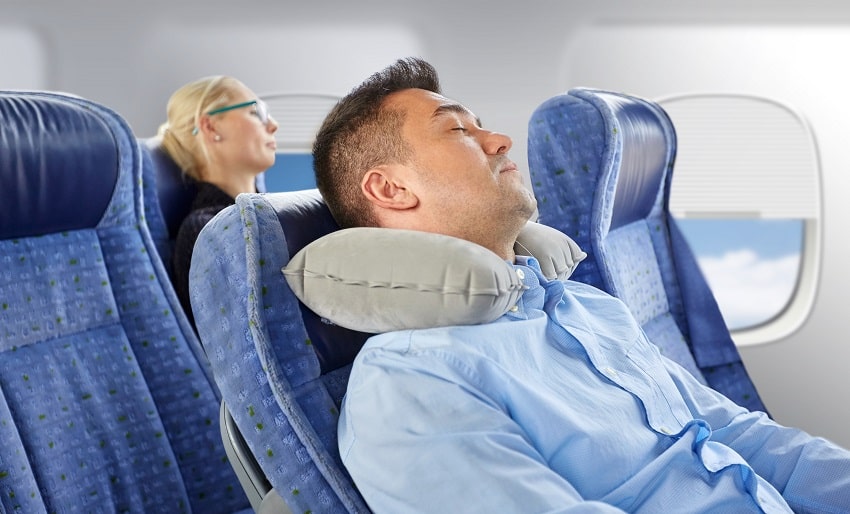
Anyone who has tried to sleep in an economy seat knows the particular misery of it. You drift off, your head nods forward, your neck cramps, and you wake with a start just as you were getting comfortable. An hour later you are doing the slow lean onto the tray table, or worse, onto a stranger’s shoulder. A good travel pillow cannot turn an economy seat into a bed, but it can make the difference between arriving wrecked and arriving functional. Modern travel pillows are the product of genuine ergonomic research, and the designs available in 2026 are far better than the flimsy inflatable rings of a decade ago. This guide explains the biomechanics of in flight sleep, how pillow design has evolved, what the science says about sleeping at 35,000 feet, and how to protect your health on long hauls.
The Biomechanical Problem: Why Sleeping Upright Hurts
Your head weighs about 10 to 11 pounds, roughly the weight of a bowling ball, and your neck muscles work constantly to hold it upright and balanced over your spine. When you fall asleep sitting up, those muscles relax, and gravity takes over. Your head nods forward or flops to one side, stretching the neck into positions it was not designed to hold. Each time your head drops, you jerk awake, which fragments your sleep and prevents you from reaching the deep sleep and REM stages where real rest happens. This is why a nap in an upright seat so often leaves you feeling worse than no sleep at all.
Researchers at TU Delft studied how passengers actually sleep in aircraft seats and found that people instinctively seek a neutral, minimal strain posture. When the head is adequately supported, sleep quality improves measurably. The key insight is that the pillow’s job is not to cushion so much as to fill the gap between the neck and the headrest, keeping the cervical spine close to its natural alignment. A pillow that is too thick behind the neck pushes the head forward into flexion, which is counterproductive. The ideal geometry, as described by The Points Guy, is a thin back panel with thicker sides that prop the head upright without forcing it to lean.
What Good Support Looks Like: The Anatomy of an Effective Travel Pillow
The classic U-shaped pillow was a reasonable first attempt, but it has a well known flaw: the opening at the front lets the chin drop, which is exactly the forward nod that wakes you up. Better designs address this directly. The Sleep Foundation describes how quality travel pillows tuck behind or around the neck, filling the space between the neck and the headrest while keeping the neck from bending too far in any direction. Harvard Health specifically recommends a horseshoe shaped pillow on planes to prevent the head from dropping to one side.
The most important design elements to look for are a flat or thin back panel so your head stays back against the seat, raised side supports that catch the head when it starts to tip, and some form of chin support or adjustable clasp that closes the front gap. Strap systems that anchor the pillow to the seat’s headrest keep everything in place when you shift in your sleep. Memory foam has largely replaced cheap polyester fill in the better models because it conforms to your shape and rebounds slowly rather than bottoming out. Some travelers prefer compressible down or bead filled designs for packability, but for pure support, contoured foam remains the benchmark. Side sleepers and tall travelers should pay particular attention to side wall height, since a pillow that is too low lets the head cantilever sideways past the support.
How Travel Pillow Design Evolved: The 2024-2025 Generation
Travel pillow design has advanced noticeably in the last few years, driven by review culture and competition among specialist brands. The premium memory foam models of 2024 and 2025 introduced dual density foam, with a firmer core for structure and a softer outer layer for comfort, flat back panels that sit flush against the seat, raised side supports, and adjustable chin clasps that close the front gap. Some designs, like the well reviewed Cabeau Evolution line, add straps that anchor to the seat headrest so the pillow cannot migrate during the flight. BBC Countryfile’s 2025 travel pillow test named the Cabeau Evolution TNE 3 its best pick for chin support, reflecting how seriously reviewers now take the chin drop problem.
It is worth being honest about the evidence. No peer reviewed randomized trial has directly measured travel pillow efficacy against a control, so claims that one brand is definitively superior rest on reviewer consensus and user feedback rather than clinical trials. Treat best of lists as informed opinion, not science. That said, the design principles behind the top rated models, neutral neck alignment, chin support, headrest anchoring, are grounded in the ergonomic research described above. When you read reviews, look for consistent praise of the same features across many reviewers rather than a single glowing write up.
The Science of In-Flight Sleep: Why You Need All the Help You Can Get
Even with perfect neck support, sleeping on a plane is physiologically harder than sleeping in bed. An analysis of 1.5 million nights of sleep data found that in flight sleep is significantly shorter and of lower quality than habitual sleep, with researchers pointing to hypobaric hypoxia from cabin pressure, the uncomfortable environment, and the shortened night as contributing factors (Willoughby et al., PMC). Cabin air is also dry, which dries out nasal passages and can make breathing less comfortable.
Research on aircraft interiors reports that the great majority of passengers on 6 to 12 hour flights attempt to sleep, but the upright position is a leading cause of discomfort, with passengers commonly reporting backache and neck pain (Longdom). This is why a multi pronged approach works best. Your pillow handles neck alignment, but you should also manage light, noise, temperature, and hydration. An eye mask, noise cancelling headphones or earplugs, and a light blanket or warm layer address the other major sleep disruptors. Avoiding caffeine in the hours before you want to sleep and limiting alcohol, which fragments sleep even though it feels sedating, also help meaningfully.
Choosing the Right Travel Pillow for Your Sleep Style
Not every traveler sleeps the same way, so the best pillow depends on your habits. If you tend to nod forward, prioritize chin support and an adjustable front clasp. If your head falls sideways, look for tall, firm side walls. If you lean against the window, a J shaped or wrap style pillow that supports one side may serve you better than a symmetric U. Back sleepers in premium economy or business class, where the seat reclines further, need less aggressive support than upright economy sleepers.
Consider packability against comfort honestly. The most supportive pillows are also the bulkiest, and a pillow you leave at home helps no one. Compressible designs that roll to half their size strike a reasonable balance for most travelers. Washability matters too, since the pillow sits against your skin for hours in a confined cabin. Removable, machine washable covers are a genuine advantage. Finally, think about your return trip. A pillow with a snap strap that attaches to your carry on handle is far less likely to be left behind in a seat back pocket. Frequent flyers who also camp should look at our family camping essentials checklist, which covers sleep gear that pulls double duty on the ground and in the air.
Beyond the Pillow: Protecting Your Health on Long Flights
A travel pillow improves comfort, but long flights carry a genuine health consideration that no pillow addresses: the risk of deep vein thrombosis, or DVT. Sitting immobile for hours slows blood flow in the legs, and on flights over 4 hours the risk of venous thromboembolism is about 1 in 4,656 person flights, according to the CDC Yellow Book. Five prospective studies of low to intermediate risk travelers on 8 plus hour flights found a 0.5 percent VTE incidence. Risk returns to baseline by about 8 weeks, with most cases occurring in the first 1 to 2 weeks after the flight.
Contrary to the old economy class syndrome label, there is no evidence that business class is safer. One study found elevated D-dimers, a clotting marker, in 12 percent of business class passengers versus 7 percent in economy, and 85 to 100 percent of travel related VTEs occur in window seat passengers, because they get up least (Mount Sinai Clinical Correlations). Immobility, not ticket class, is the driver. The CDC recommends walking the cabin occasionally, doing seated calf muscle exercises, choosing an aisle seat when possible, and staying hydrated. For travelers at increased VTE risk on flights of 6 hours or more, fitted below the knee graduated compression stockings at 15 to 30 mmHg ankle pressure are recommended. If you develop leg swelling, pain, or warmth after a flight, or sudden shortness of breath, seek medical care promptly.
Beating Jet Lag: Arriving Rested and Ready
Jet lag is a circadian rhythm disorder, not just tiredness, and it hits hardest when you cross three or more time zones. The CDC advises timing your sleep, meals, and light exposure to the destination time zone as soon as you board, keeping daytime naps to 15 to 20 minutes, staying hydrated, avoiding excess alcohol, and minimizing caffeine late in the day. Warm cabin air and low humidity accelerate dehydration, so drink water steadily rather than waiting until you feel thirsty.
Cleveland Clinic adds practical in flight habits: drink plenty of water, avoid caffeine and alcohol, and keep moving with small exercises like rolling your feet, raising your knees, turning your head, and walking the cabin periodically. Eastward travel, which shortens your day, is generally harder than westward travel. For trips longer than a few days, morning sunlight at your destination is the strongest signal for resetting your clock. Travelers heading somewhere adventurous after landing may enjoy our guides to overnight camping in the Dubai desert and memorable overnight camping for inspiration once you are rested.
Packing, Cleaning, and Getting the Most from Your Pillow
Treat your travel pillow as sleep equipment, not an accessory. Before a trip, test it at home in a chair to find the right strap tension and clasp position. Pack it where it is accessible, clipped to your personal item rather than buried in the overhead bin. After each trip, wash the cover according to its instructions, and air out the foam insert. Replace the pillow when the foam stops rebounding, usually after a couple of years of regular use, since flattened foam no longer supports neutral alignment.
A travel pillow will not fix a bad seat, a crying baby three rows back, or turbulence. But combined with an eye mask, earplugs, sensible hydration, movement, and realistic expectations, it is one of the highest value upgrades a frequent flyer can make. Your neck will thank you on arrival, and so will the stranger you no longer lean on.
Red-Eye Strategy: Putting It All Together
The travelers who sleep best on overnight flights treat the cabin like a system, not a single problem. Start before boarding: choose a window seat if you want a wall to lean on, or an aisle seat if you plan to get up and move for circulation. Eat a light meal at the airport rather than waiting for the full cabin service, which can keep you awake for the first two hours of the flight. Once the seatbelt sign is off, set up your sleep station immediately: pillow fitted and clasped, eye mask on, earplugs or noise cancelling headphones in, blanket arranged, and water bottle in the seat pocket.
Resist the urge to watch one more episode. The blue light and the engagement both delay sleep onset, and on a six hour red eye, every lost half hour matters. If your mind races, a simple breathing routine, slow inhale through the nose and longer exhale through the mouth, helps transition toward rest. Set a quiet alarm for about 45 minutes before landing so you wake gently, hydrate, and stretch before the cabin lights come up. Travelers who follow this routine consistently report arriving noticeably more functional, and the pillow is the linchpin that makes the rest of it work. Without neck support, even the best eye mask cannot stop the head nod cycle that keeps resetting your sleep.
Frequently Asked Questions
Do travel pillows really help you sleep on planes?
They help by solving the main mechanical problem of upright sleep: the unsupported head. By filling the gap between your neck and the headrest and keeping your cervical spine near neutral alignment, a good pillow prevents the head nod that fragments sleep. No peer reviewed trial has tested pillows directly, but ergonomic research on passenger sleep posture supports the design principles behind the best models.
What is the best type of travel pillow for neck pain?
Look for a contoured memory foam design with a thin back panel, raised side supports, and an adjustable chin clasp or strap. The thin back keeps your head against the seat instead of pushing it forward, while the sides and chin support catch the head when it starts to tip. Reviewers in 2025 consistently praised models with these features, though you should treat brand rankings as informed opinion rather than clinical proof.
How do I stop my head from falling forward when sleeping upright?
Chin support is the key. Choose a pillow with a front clasp or wrap design that closes the gap at the throat, and anchor the pillow to the seat headrest with straps if available. Reclining your seat even slightly reduces the forward moment on your head. Avoid thick pillows behind the neck, which paradoxically push the head further forward.
Are travel pillows bad for your neck?
A well designed pillow used correctly is not harmful, but a poor one can be. Pillows that are too thick behind the neck force flexion, and very soft pillows that bottom out offer no real support. If you wake with new or worsening neck pain after using one, the fit or firmness is wrong for you. People with existing cervical spine conditions should check with their clinician before relying on a travel pillow.
How can I reduce DVT risk on a long flight?
Walk the cabin occasionally, do seated calf exercises, choose an aisle seat so you can get up easily, and stay hydrated. The CDC recommends fitted below the knee compression stockings at 15 to 30 mmHg for higher risk travelers on flights of 6 hours or more. Seek prompt medical care for leg swelling or pain, or sudden shortness of breath, after a flight.
What is the best way to beat jet lag after landing?
Shift your schedule to destination time as soon as you board, get morning sunlight at your destination, keep naps to 15 to 20 minutes, stay hydrated, and limit alcohol and late caffeine. Eastward travel is usually harder than westward. For most travelers, the clock resets within a few days with consistent light exposure and sleep timing.
Note: This article is for general information only and is not medical advice. If you have a neck or spine condition, circulation problems, or a history of blood clots, consult your clinician before long haul travel.
