



Originally published: June 24, 2020. Last updated: Oct 11, 2026.
Choosing where to study abroad usually comes down to three practical questions: which universities are strongest in your field, what the degree will cost, and whether you can work and stay on after graduation. This guide ranks the leading universities in Ireland using the QS World University Rankings 2026 and the Times Higher Education World University Rankings 2026, then covers tuition fees, scholarships, student visa rules, and post-study work options. If you are still weighing destinations, our guide to the reasons to study abroad can help you compare.
Why International Students Choose Ireland
Ireland is an English-speaking member of the European Union, which makes it a natural alternative for students who want an English-language degree inside the EU. The country hosts the European bases of many global technology and pharmaceutical companies, and that industry presence feeds directly into graduate hiring, internships, and research partnerships at Irish universities.
Quality of life is another draw. Ireland placed 13th out of 147 countries in the World Happiness Report 2026, making it one of the highest-ranked English-speaking countries in the survey. The higher education system is compact and readable: Ireland has eight public universities, and all eight appear in the QS World University Rankings 2026, so applicants can compare the whole sector on one scale.
Top 10 Universities in Ireland for International Students
The list below is ordered by the QS World University Rankings 2026, published in June 2025, with each university’s Times Higher Education World University Rankings 2026, published in October 2025, with each university’s position shown as a second reference point. The THE 2026 Irish placements used here follow Trinity News’ coverage of that release. One housekeeping note: some older guides still list the Dublin Institute of Technology as a separate university. It merged into Technological University Dublin in January 2019, so it appears once here, under its current name.
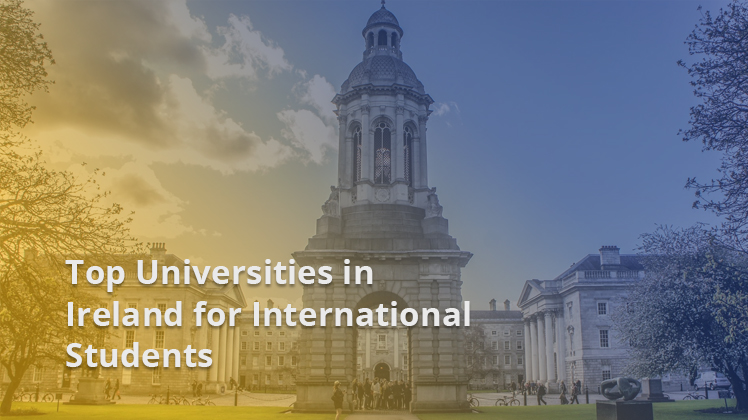
1. Trinity College Dublin
Founded in 1592 in Dublin city centre, Trinity is Ireland’s oldest university and its highest-ranked in both major ranking systems: 75th in the QS World University Rankings 2026, its best position in a decade and the only Irish entry inside the world top 100, and 173rd in the THE World University Rankings 2026. Trinity leads Ireland across most QS subject areas, with nursing ranked 10th in the world in the QS 2026 subject tables. Full details are on Trinity’s official rankings page. It suits students who want maximum global brand recognition, particularly in humanities, law, medicine, and computer science.
2. University College Dublin
Founded in 1854 and based at Belfield in Dublin, UCD is Ireland’s largest university, with well over 30,000 students. It ranks 118th in the QS World University Rankings 2026 and sits in the 201-250 band of the THE World University Rankings 2026. UCD is known for its Smurfit Graduate Business School, engineering, agriculture, and Ireland’s only veterinary medicine school. It is a strong pick for business, data-heavy, and science programs where scale brings more course options and research funding.
3. University College Cork
Founded in 1845 in Ireland’s second city, UCC ranks 246th in the QS World University Rankings 2026 and in the 351-400 band of the THE World University Rankings 2026, as shown on UCC’s rankings page. It is a research-intensive university with particular depth in food science, medicine, pharmacy, and sustainability. Cork offers a lower cost of living than Dublin, which makes UCC attractive for students balancing quality with budget.
4. University of Galway
Founded in 1845 on Ireland’s west coast, this university was known as NUI Galway until its renaming as the University of Galway in 2022, so older guides may use the former name. It ranks 284th in the QS World University Rankings 2026 and in the 351-400 band of the THE World University Rankings 2026. Strengths include medicine, arts, and social sciences, and Galway’s compact, student-friendly city is consistently popular with international students.
5. University of Limerick
Founded in 1972, UL ranks around 401st in the QS World University Rankings 2026. It pioneered the co-operative education model in Ireland, building paid work placements into many degree programs, which underpins its strong graduate employment record. Engineering, science, business, and health sciences are its core areas, and it is widely regarded as having some of the best sports facilities of any Irish university. It suits career-focused students who value structured industry experience during the degree.
6. Dublin City University
Founded in 1975 in north Dublin, DCU ranks around 408th in the QS World University Rankings 2026 and in the 301-350 band of the THE World University Rankings 2026, according to DCU’s official rankings page. It is a young, deliberately industry-facing university: its INTRA work placement program is built into undergraduate degrees, and it performs strongly in business, computing, communications, and education. A good fit for students who want a practical, employment-linked degree in the capital.
7. Maynooth University
Based in the historic town of Maynooth in County Kildare, just outside Dublin, Maynooth became an independent university in 1997, with institutional roots going back to 1795. It ranks in the 771-780 band of the QS World University Rankings 2026. A humanities-and-sciences university with a smaller, more collegiate feel than the Dublin giants, it works well for students who prefer a quieter campus town with easy access to the capital.
8. Technological University Dublin
TU Dublin was established in January 2019 from the merger of the Dublin Institute of Technology, IT Blanchardstown, and IT Tallaght, making it Ireland’s first technological university. It ranks in the 781-790 band of the QS World University Rankings 2026. Its focus is applied and technological education: computing, engineering, architecture, design, and business, taught with a hands-on, career-oriented approach. It is the natural choice for students who prefer practical degrees over research-led ones.
9. RCSI University of Medicine and Health Sciences
Founded in Dublin in 1784, RCSI is a specialist medicine and health sciences institution rather than a comprehensive university, so it does not sit on the same QS overall axis as the universities above. It ranks in the 251-300 band of the THE World University Rankings 2026 and holds QS subject placements in medicine, pharmacy, and nursing. Its student body is unusually international, which matters for students seeking a globally mixed medical cohort. Consider it only for health-related degrees.
10. Atlantic Technological University and South East Technological University
Ireland’s two newest universities complete the list. The Atlantic Technological University was established in April 2022 and the South East Technological University in May 2022, bringing the country’s total to five technological universities, as documented by the Higher Education Authority and the Irish government’s announcement of the ATU launch. Both offer applied, career-focused degrees across regional campuses, generally at lower tuition levels than the older universities. They sit lower in the global rankings, so weigh them for value and employability rather than worldwide brand.
Ireland Universities: 2026 Rankings at a Glance
Rankings move every year, so treat the table below as a 2026 snapshot and check the current edition before applying.
| University | QS World 2026 | THE World 2026 | Location |
|---|---|---|---|
| Trinity College Dublin | 75 | 173 | Dublin |
| University College Dublin | 118 | 201-250 | Dublin |
| University College Cork | 246 | 351-400 | Cork |
| University of Galway | 284 | 351-400 | Galway |
| University of Limerick | ~401 | 501-600 | Limerick |
| Dublin City University | ~408 | 301-350 | Dublin |
| Maynooth University | 771-780 | 501-600 | Maynooth |
| Technological University Dublin | 781-790 | Outside top 1000 | Dublin |
| RCSI (specialist) | Not on QS overall table | 251-300 | Dublin |
Tuition Fees in Ireland for International Students (2026/27)
Tuition varies by university and program, and the figures below are typical ranges for non-EU students for the 2026/27 academic year. Always confirm the exact fee on the university’s official fee schedule before budgeting, because fees change annually.
- Undergraduate degrees: roughly 10,000 to 25,000 euros per year. Technological universities and regional universities tend toward the lower end of this range.
- Postgraduate taught degrees: roughly 10,000 to 35,000 euros per year, with business, data science, and specialist programs at the higher end.
- Medicine, dentistry, and veterinary medicine: 50,000 euros or more per year, among the most expensive programs in the country.
- Living costs: the Irish Immigration Service estimates 10,000 euros per academic year for a student’s living expenses, and Dublin costs more than regional cities.
Beyond tuition, budget for the immigration costs: registering your permission costs 300 euros per year, and a single-entry study visa costs 60 euros. Details are on the Irish Immigration Service’s student finances page.
Ireland Student Visa and Work Rules
Non-EU and non-EEA students need an immigration permission to study in Ireland. The essentials, per the Irish Immigration Service, are:
- Enrol on a full-time course listed on the Interim List of Eligible Programmes (ILEP). Since 2025, institutions recruiting visa-requiring students must also hold authorisation under the TrustEd Ireland scheme.
- Show access to at least 10,000 euros for courses lasting more than eight months, plus course fees and 10,000 euros for each subsequent year. For shorter courses, the requirement is 833 euros per month of stay, up to 6,665 euros. Provide six months of bank statements for yourself and any sponsor.
- Hold private medical insurance for the full duration of your studies.
- Register your Stamp 2 student permission after arrival (300 euros per year).
Stamp 2 holders may work up to 20 hours per week during term time and up to 40 hours per week during holidays. English-language requirements are set by each university and program, so check the admissions page of your chosen course rather than assuming one test fits all.
Staying in Ireland After Graduation: the Stamp 1G Option
Ireland offers one of the more generous post-study arrangements in Europe through the Third Level Graduate Programme. After completing a degree at a recognised Irish institution, non-EEA graduates can move to a Stamp 1G permission to seek graduate-level employment and apply for an employment permit, according to the Irish Immigration Service and the Irish Council for International Students (ICOS):
- Level 8 award (Honours Bachelor’s degree): up to 12 months on Stamp 1G.
- Level 9 or 10 award (Master’s or PhD): up to 24 months, granted as two 12-month blocks.
- Stamp 1G holders may work up to 40 hours per week while job hunting.
- Total time on the student pathway is capped: seven years for Level 8 graduates, eight years for Level 9 and above.
This stay-back window is a major reason Ireland competes with the UK for international students, since it gives graduates real time to convert a degree into an employment permit without leaving the country.
Scholarships for International Students in Ireland
Most Irish universities run their own international scholarships, usually as partial tuition waivers awarded on academic merit; Trinity and UCD both advertise global scholarship schemes for non-EU applicants, though the eligible programs and award levels change each year. The Irish government also funds the Government of Ireland International Education Scholarship for high-achieving non-EU students. Because scholarship terms shift annually, shortlist the awards on each university’s international office page and note the deadlines before you apply. For a broader view of funding routes, see our guide to the types of scholarships in Europe.
How to Choose the Right Irish University
Rankings are a starting filter, not the decision. A few practical rules help more:
- Prioritise subject strength over headline rank. A university ranked 400th overall can be world-class in your specific field, so check QS subject rankings for your discipline.
- Weigh Dublin against regional cities. Dublin offers the most employers and the highest living costs; Cork, Galway, and Limerick cut accommodation costs significantly.
- Value structured work experience. UL’s co-operative education model and DCU’s INTRA placements build employer contact into the degree itself.
- Match the teaching style to your goals. The technological universities suit hands-on, career-focused learners; Trinity, UCD, UCC, and Galway suit research-oriented ones.
- Confirm immigration eligibility. Only apply to institutions authorised under the TrustEd Ireland scheme if you need a student visa.
Frequently Asked Questions
Which is the best university in Ireland for international students?
Trinity College Dublin is Ireland’s top-ranked university in both the QS World University Rankings 2026 (75th) and the THE World University Rankings 2026 (173rd), and it is the only Irish university inside the QS world top 100. That said, the “best” choice depends on your subject: UCD leads in business and agriculture, UCC in food science and medicine, and UL and DCU in employment-linked programs with built-in work placements.
How much does it cost for an international student to study in Ireland?
Non-EU undergraduate tuition typically runs from 10,000 to 25,000 euros per year, postgraduate programs from 10,000 to 35,000 euros, and medicine from 50,000 euros upward. The Irish Immigration Service estimates living costs at about 10,000 euros per academic year. Figures are for 2026/27 and change yearly, so confirm fees on the university’s official schedule.
Can international students work while studying in Ireland?
Yes. Students on a Stamp 2 immigration permission may work up to 20 hours per week during term time and up to 40 hours per week during official holidays. You must be enrolled full-time on an eligible program and maintain the required attendance.
Can I stay in Ireland after I graduate?
Yes, through the Third Level Graduate Programme. Graduates with a Level 8 award (Honours Bachelor’s) can get up to 12 months on a Stamp 1G permission, and graduates with a Level 9 or 10 award (Master’s or PhD) can get up to 24 months. Stamp 1G holders may work up to 40 hours per week while seeking graduate-level employment or an employment permit.
Do Irish universities require IELTS?
English-language requirements vary by university and program, so check the admissions page of your chosen course for the accepted tests and minimum scores. If English test requirements are a deciding factor for you, our related guide on UK universities that accept applications without IELTS shows how a neighbouring destination handles alternatives.
Which Irish universities are in the world top 300?
In the QS World University Rankings 2026, four Irish universities sit inside the world top 300: Trinity College Dublin (75th), University College Dublin (118th), University College Cork (246th), and the University of Galway (284th).
Comparing destinations before you decide? See our ranking of the top universities in the UK for international students to weigh Ireland against its closest alternative.
