



Originally published: April 4, 2021. Last updated: Oct 10, 2026.
Trade shows still put your product in front of people who can buy it, which is why booth traffic matters so much. The visitors walking past your stand are not casual browsers; most of them came to the show with a purchasing problem to solve. Winning their attention for even a few minutes is the difference between an expensive three days and a pipeline full of qualified conversations.
This guide is a practical 2026 playbook for exhibitors: how to promote your stand before the show, design a booth that stops foot traffic, staff it well, run engagement that pulls people in, capture leads that convert, and measure whether the whole exercise was worth it. Use the checklists at the end to turn the plan into action.
Why Booth Traffic Is Harder to Win (and More Valuable) in 2026
Trade shows have largely recovered their audiences, but exhibiting has become more competitive and more expensive. According to the Center for Exhibition Industry Research (CEIR) Q2 2025 Index, reported by EXHIBITOR Magazine, attendee levels were only 3.7% below Q2 2019, the strongest recovery of any exhibition metric, although just 32.7% of events had fully surpassed their pre-pandemic performance. In other words, the crowds are back, but exhibitors are still fighting hard for their share of attention.
The prize is worth the fight. CEIR research finds that 81% of trade show attendees have buying authority and 92% attend looking for new products. Few other marketing channels put you face to face with that concentration of motivated buyers for three straight days. The exhibitors who win are not the ones with the biggest stands; they are the ones who plan the full journey, from the first pre-show email to the last follow-up call.
Win Half Your Traffic Before the Show Opens
Most booth traffic is decided before the doors open. The exhibitors with queues on day one are the ones who treated the show like a product launch, not a surprise party. Start your outreach four to six weeks before the event and keep it going until the morning the show opens.
Start promoting 4 to 6 weeks out
- Run a short email sequence. Send a teaser six weeks out, the full invitation with your booth number and any show-only incentive three weeks out, and a reminder 48 hours before the doors open.
- Put your booth number in every communication. Emails, social posts, your website banner, and staff email signatures should all tell people exactly where to find you.
- Post like an exhibitor, not a spectator. Share countdown posts, behind-the-scenes setup shots, and sneak peeks of demos or giveaways using the event hashtag. Ask your team to post on their personal LinkedIn profiles too; personal posts consistently reach further than company page posts.
- List yourself properly. Complete your exhibitor directory listing early with your booth number, a clear one-line description, and the demos or giveaways visitors can expect.
This is where understanding what strong marketing does for business success pays off: pre-show promotion is marketing with a deadline, and every touchpoint should drive one action, which is a visit to your stand.
Book meetings before you arrive
Do not rely on foot traffic alone. Personally invite your top 20 to 30 accounts and prospects, and include a scheduling link so they can book a slot at your stand. Aim to arrive with a diary of confirmed conversations rather than hoping they happen. Even ten pre-booked meetings change the economics of the show.
Choose the right show and the right spot
No tactic rescues a stand at the wrong event. Match the show’s audience to your target buyer before you book, and review the different types of business events to plan for so you exhibit where your buyers actually gather. Then study the floor plan: corner positions on main aisles get roughly double the approach opportunities of mid-row inline spaces, spots near entrances and registration catch attendees when their energy is highest, and locations near food courts, lounges, and stages benefit from natural linger zones.
Design a Stand That Stops Foot Traffic
An attendee decides whether to stop at your booth in about three seconds. Your design job is to make those three seconds work: one clear message, visible from a distance, with nothing blocking the way in.
Pass the 3-second test
- One headline, one benefit. State who you are and why a visitor should care in a single short line. Supporting text should be minimal; nobody reads paragraphs from the aisle.
- Make it readable from far away. Use large, bold type and high-contrast colors, and test visibility from 20 feet, 50 feet, and across the aisle before you finalize anything.
- Put the primary message at eye level. TSNN’s trade show signage guidance recommends the 5-second rule for graphics, one primary message with two or three supporting points, and placement where foot traffic is heaviest.
- Refresh your print materials. Banners, backdrops, and handouts should match your current branding and message. Review print advertisement formats that still earn attention to make sure your on-stand print is doing real work instead of filling space.
Keep the front open and build three zones
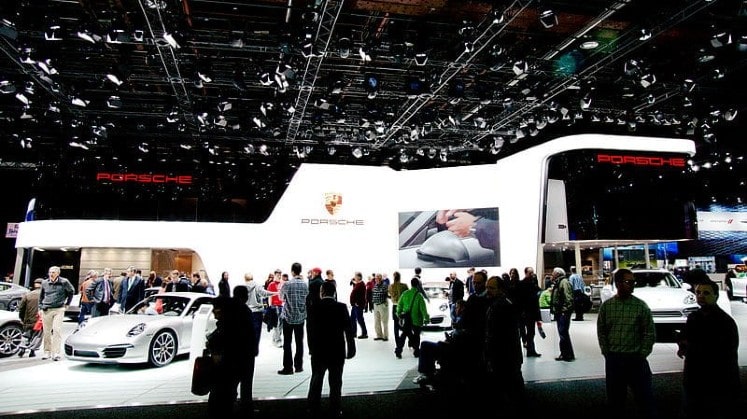
Never put a table, counter, or display at the aisle edge; it creates a physical and psychological barrier that tells attendees to keep walking. Instead, keep the first few feet of your stand clear and organize the space into three zones: an engagement zone at the front where staff start conversations, a demonstration zone in the middle for product demos and interactive screens, and a consultation zone at the back for deeper talks with qualified prospects. Make sure every graphic and color reinforces a consistent brand identity so visitors recognize you from across the hall.
Use light, motion, and height
Backlit displays and spotlights on your products create visual drama that flat graphics cannot match. Motion signals activity, and activity signals value: live screens, looping demo videos, and people interacting with your stand make passersby pause almost involuntarily. Add height with hanging signs or tall structures so your stand is visible down the aisle. And treat QR codes as your digital brochures, as TSNN recommends, so detailed information lives on the visitor’s phone instead of cluttering your walls.
Staff the Stand Like It Matters
Great design gets people to stop; great staff turns stops into conversations. Choose your friendliest, most knowledgeable people, not whoever happens to be available, and train them before the show. The rules are simple: stand near the aisle, make eye contact, approach visitors proactively with an open question, and never huddle with colleagues or stare at a phone. Assign clear roles, a greeter to start conversations, a demo lead to run presentations, and someone responsible for qualifying and logging leads, and hold a short briefing each morning to review the day’s goals, demo schedule, and any VIP visits.
Run Engagement That Pulls People In
Passive stands get passed. Build your schedule around activities that give people a reason to stop, stay, and talk.
- Run live demos facing the aisle. Demonstrations are among the most effective traffic builders because the action itself becomes a visual magnet. Position the demo so the activity faces the walkway, run it on a published schedule, and announce each session in advance.
- Make it hands-on. Touchscreens with product configurators, tablets with quick quizzes, and VR or AR experiences let visitors interact instead of just watching. Keep the interaction obvious: visitors should be able to tap and start without instructions.
- Run a contest or game. A prize wheel, product challenge, or leaderboard-driven quiz gives staff a natural conversation starter and gives attendees a reason to remember you. Trade Show News Network (TSNN) notes that a well-chosen trade show game can increase booth traffic, spark conversations, and lift ROI. Borrow game mechanics that work for events, points, challenges, and instant rewards, and tie the game to your product so the fun carries your message.
- Create a comfort zone. Seating, refreshments, and phone charging stations convert casual passersby into prospects who linger, and lingering leads to conversations.
Offer Giveaways People Actually Keep
Freebies work, but only when they are worth keeping. Cheap generic items get binned before the visitor reaches the next aisle, which means your logo goes with them. Choose items that are useful, good quality, and connected to your brand, and consider tiering: a small branded item for every visitor, and a genuinely desirable item reserved for qualified prospects who complete a demo or consultation. A giveaway tied to an activity, such as completing your quiz or attending a demo, earns far more engagement than a bowl of pens on a table.
Capture Every Lead Without Killing the Conversation
A badge scan gives you a name; a short conversation gives you the buying stage, the budget cycle, and the actual pain point. Your system needs to capture both. Use badge scanners or a lead-retrieval app so capture takes seconds, then train staff to ask two qualifying questions on the spot, for example what problem brought them to the show and what timeline they are working to, and log the answers immediately. Tag each lead as hot, warm, or cold before the visitor walks away, and review the day’s leads every evening so nothing slips through. Cvent’s 2026 guidance on trade show lead collection stresses the same principle: focus the in-booth conversation on one clear problem, and the engagement and the capture take care of themselves.
Follow Up While the Show Is Still Warm
Most exhibitors lose the game after the show, not during it. Send the first follow-up within 24 to 72 hours, while the conversation is still fresh in the visitor’s mind. Reference what you actually discussed, not a generic “great to meet you”: if they told you their current supplier’s lead times are hurting production, open with that pain and how you solve it. Prioritize hot leads for personal calls, nurture warm leads with relevant content, and make sure every lead is tagged with the show as its source in your CRM so you can trace revenue back to the event months later.
Measure What Mattered
You cannot improve what you do not measure, and “it felt busy” is not a metric. After every show, record the numbers that justify the investment:
- Total event cost: space, stand build, freight and drayage, utilities, travel, staff time, sponsorships, and follow-up labor.
- Traffic and engagement: booth visits, demo attendees, contest participants, and average dwell time.
- Lead quality: total leads captured, share that were qualified, and cost per qualified contact.
- Speed: time from capture to first follow-up, and share of leads followed up within 72 hours.
- Revenue impact: opportunity rate by event, and pipeline and revenue influenced, not just lead volume.
Compare these against your previous shows and your other marketing channels. Exhibiting is expensive, and the data is what tells you whether to book a bigger stand next year, change your position on the floor, or skip the show entirely.
Your Exhibitor Checklists
Pre-show: 4 to 6 weeks out
- Set one measurable goal: leads, meetings, product launch buzz, or brand awareness.
- Confirm the show matches your target audience and choose the best booth position you can afford.
- Launch the email sequence and put your booth number in every communication.
- Schedule social countdown posts and brief staff on personal LinkedIn posting.
- Personally invite top accounts and pre-book meetings with a scheduling link.
- Finalize booth design: one headline, open front, three zones, lighting, QR codes.
- Order giveaways, print materials, and demo equipment; test all technology.
- Roster and train booth staff; rehearse demos and qualifying questions.
- Set up the lead capture system and CRM source tags.
Show days
- Arrive early; test screens, scanners, lighting, and demos before doors open.
- Hold a morning briefing: goals, demo schedule, VIP visits, roles.
- Staff the aisle proactively; no phones, no huddling.
- Run demos and contests on schedule; announce each session.
- Scan and qualify every meaningful conversation; tag leads hot, warm, or cold.
- Post live content with the event hashtag.
- Hold an end-of-day debrief and review the day’s leads.
Post-show: the week after
- Send personalized follow-ups within 24 to 72 hours.
- Enter all leads in the CRM with the show tagged as the source.
- Call hot leads; nurture warm leads with relevant content.
- Hold a team debrief: what worked, what failed, what to change.
- Compile the ROI report: cost per qualified contact, opportunity rate, pipeline influenced.
- Decide on next year: rebook, resize, relocate, or skip.
Frequently Asked Questions
How far in advance should I start promoting my exhibition stand?
Start four to six weeks before the show. Send a teaser email six weeks out, the full invitation with your booth number and any show-only incentive three weeks out, and a reminder 48 hours before the doors open. Announce your presence on social media and complete your exhibitor directory listing early so attendees can plan to visit you.
What is the 3-second rule for exhibition booths?
An attendee decides whether to stop at your booth in about three seconds, so your graphics must communicate who you are and why you matter almost instantly. Use one clear headline, one primary benefit, minimal supporting text, high-contrast colors, and type large enough to read from across the aisle.
How should I lay out my exhibition stand?
Keep the front fully open with no tables or counters at the aisle edge, and organize the space into three zones: an engagement zone at the front for starting conversations, a demonstration zone in the middle for demos and interactive screens, and a consultation zone at the back for deeper talks with qualified prospects. Position staff near the aisle, not behind furniture.
How do I capture leads at my booth without slowing down conversations?
Use a badge scanner or lead-retrieval app so capture takes seconds, then ask two quick qualifying questions, such as what problem brought them to the show and what timeline they are working to, and log the answers on the spot. Tag each lead as hot, warm, or cold before the visitor walks away.
What giveaways actually work at trade shows?
Useful, good-quality items connected to your brand. Tier your giveaways: a small branded item for every visitor and a more desirable item reserved for qualified prospects who complete a demo or consultation. Giveaways tied to an activity earn far more engagement than items sitting in a bowl.
How do I measure my exhibition stand ROI?
Compare your total event cost against qualified leads generated, cost per qualified contact, time from capture to first follow-up, opportunity rate, and pipeline and revenue influenced. Tag every lead with the show as its source in your CRM so you can trace revenue back to the event, and benchmark the results against your previous shows.
Keep Reading
- Top 3 Different Types of Events to Plan for Businesses 2026
- How to Create a Brand Identity: Beginner’s Guide (2026)
- 5 Print Advertisement Types That Boost Sales (2026)
- What Marketing Does for Business Success (2026)
- Gamification Ideas for Virtual Events: Top 10 Picks
