



Originally published: Dec 29, 2022. Last updated: Oct 13, 2026.
Choosing a multifunction printer looks simple until the quotes arrive. One vendor pushes a color laser workhorse, another swears by ink-tank, a third says you should lease and never think about it again, and the prices differ by an order of magnitude. The confusion is understandable: “multifunction printer” covers everything from a $200 desktop unit to a $20,000 departmental machine, and the right choice depends on print volume, color needs, and how much you want to spend per page over the machine’s life.
This guide lays out the printer types businesses actually choose between in 2026, laser and inkjet in their modern forms, desktop and workgroup sizes, and the ownership models around them, with current market data and cost-per-page benchmarks so you can compare total cost instead of sticker price.
What counts as a multifunction printer in 2026
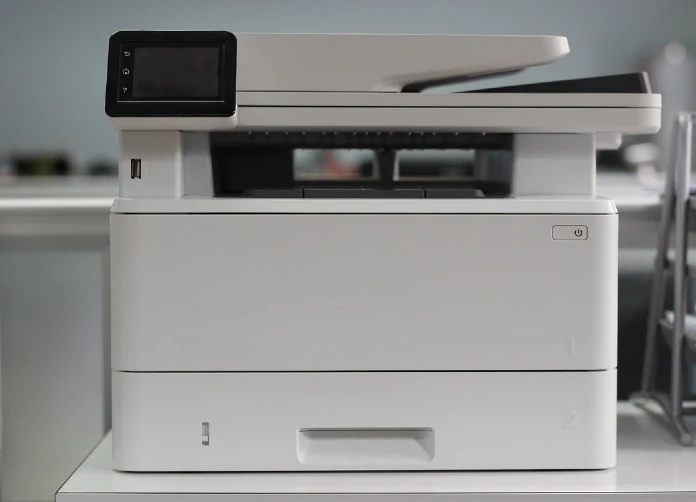
A multifunction printer (MFP), also called an all-in-one, combines printing, copying, scanning, and usually faxing in a single device. Modern MFPs are network endpoints: they scan directly to email and cloud storage, authenticate users with badges or PINs, run apps on touchscreen panels, and report supply levels and service needs automatically. The category dominates the market: TonerBuzz’s 2026 printer market snapshot notes multifunction devices held over 60 percent of 2025 printer market revenue, and Mordor Intelligence values the global MFP market at $20.58 billion in 2025, growing toward $25.32 billion by 2030.
The useful way to split the category is by print technology first, then by size class. Technology determines your cost per page and output character; size determines whether the machine survives your monthly volume.
Monochrome laser MFPs: the office workhorses
Black-and-white laser MFPs remain the default for text-heavy offices: fast, sharp, and cheap to run. GM Insights reports multifunction devices accounted for 55.6 percent of global laser printer revenue in 2025, and monochrome laser MFPs specifically dominate the small and midsize business segment on cost-per-page economics. Dataintelo’s 2025 benchmarks put laser cost per page at roughly 0.8 to 1.2 cents for monochrome, the lowest in the industry.
Choose mono laser when most of your output is documents, invoices, contracts, and internal paperwork, and you print hundreds to thousands of pages a month. Toner does not dry out or clog the way ink can, so these machines tolerate idle weeks better than inkjets, a real advantage for offices with uneven print patterns. If you print mostly in black and white, see our small business printer recommendations for how the category breaks down in practice.
Color laser MFPs: for offices that live in color
Color laser MFPs add full-color output at workgroup speeds, suited to marketing teams, real-estate offices, schools, and any business producing presentations, brochures, and client-facing documents in volume. Color cost per page runs roughly 3 to 5 cents on laser, per Dataintelo, which beats outsourcing short runs to a print shop once volume justifies the hardware.
The trade-off is upfront cost and footprint: color laser workgroup machines are bigger, heavier, and pricier than their mono siblings, and they consume more power. Buy color laser when color is a weekly need at real volume, not an occasional want; for occasional color alongside heavy mono, a mono workhorse plus a small color desktop unit is often the cheaper fleet. Our color laser picks for small business compare the options.
Inkjet and ink-tank MFPs: the rising challengers
The most interesting movement in the 2026 printer market is on the inkjet side. IDC’s Q1 2025 hardcopy peripherals tracker found worldwide shipments up 2.7 percent year over year, with ink-tank devices posting their fourth consecutive quarter of global growth, driven by refillable ink systems that slash running costs and waste. Mordor Intelligence calls inkjet the fastest-growing MFP technology at a 5.87 percent CAGR, and Fortune Business Insights projects the inkjet segment growing fastest through 2034 as businesses shift to ink-tank platforms.
Two distinct products live here. Cartridge inkjet MFPs are cheap to buy and expensive to run, with Dataintelo benchmarking inkjet at roughly 2 to 4 cents per mono page and 8 to 12 cents per color page. Ink-tank (supertank) MFPs cost more upfront but include bottles yielding thousands of pages, collapsing the per-page cost toward laser territory while keeping inkjet’s superior photo and color quality. Business inkjet lines have also grown up: faster page-wide printheads now compete with laser on speed for mixed office workloads. Choose ink-tank when you need quality color at moderate volumes and want the lowest total cost without a workgroup laser’s footprint; design-heavy teams should also see our printer picks for graphic design.
A3 vs A4, desktop vs workgroup: sizing the machine
Technology is half the decision; duty cycle is the other half. Desktop (A4) MFPs suit individuals and small teams printing a few hundred pages a month. Workgroup (A3-capable) machines handle thousands of pages a month across a department, with larger paper trays, faster processors, finishing options like stapling and booklet-making, and the management features IT departments expect. Dataintelo notes A3 office devices held 60 percent of 2025 A3/A4 MFP value, while A4 models grow faster on ink-tank and business-inkjet demand.
Match the machine’s rated monthly duty cycle to your real volume with headroom: a desktop unit run at its maximum rating will jam, wear, and frustrate. If two departments share one machine and queues form, you do not need a faster printer, you need a second printer or a workgroup-class upgrade.
Total cost of ownership: do the cost-per-page math
The sticker price is the smallest part of what a printer costs. Over a five-year life, supplies dominate, which is why cost per page is the number that matters. Using Dataintelo’s 2025 benchmarks: a mono laser at ~1 cent a page costs about $50 per 5,000 pages in toner; a cartridge inkjet at ~10 cents a color page costs $500 for the same output. Multiply by your monthly volume and the “cheap” printer becomes the expensive one within a year.
Build the full comparison: hardware price plus expected supplies over three to five years, plus paper, plus energy, plus service. Then add the soft costs: an unreliable printer’s downtime, IT tickets, and reprints. This is also where managed print services earn their keep: a per-page contract bundles hardware, supplies, and service into one predictable number, which many businesses prefer once the fleet passes a handful of devices.
Security features to require
Printers are network computers with hard drives that store images of everything they print, scan, and copy, and they are among the most neglected devices in office security. Require user authentication (badge, PIN, or login) with pull printing, so jobs only print when the user is at the machine; encrypted storage and secure erase; regular firmware updates from a vendor with a real security program; and network segmentation guidance so the printer fleet does not sit flat on the main LAN. If your industry has compliance obligations, confirm the device and its workflows meet them before purchase, not after.
Lease vs buy vs managed print
Buying suits stable, predictable print volumes: you own the asset, control supplies sourcing, and the per-page cost falls over time. Leasing suits businesses that want predictable monthly spend, regular technology refreshes, and bundled service; read the fine print on page allowances, overage rates, and end-of-term buyout or return conditions. Managed print services (MPS) go further, wrapping hardware, supplies, monitoring, and service into a per-page price with usage analytics that usually reveal the fleet is bigger than it needs to be.
Whichever model you choose, get the service terms in writing: response-time guarantees, what counts as a billable visit, and who supplies consumables. A lease without a service SLA is just an expensive rental.
Frequently asked questions
What are the main types of multifunction printers?
The main split is by print technology: monochrome laser, color laser, and inkjet, with ink-tank models as the fast-growing inkjet subcategory. By size, they divide into desktop (A4) units for individuals and small teams and workgroup (A3-capable) machines for departments. Match technology to your color needs and size to your monthly volume.
Laser vs inkjet multifunction printer: which is better for business?
Laser wins for high-volume text and the lowest cost per page, around 0.8 to 1.2 cents for mono. Ink-tank inkjet wins for quality color at moderate volumes with very low running costs. Cartridge inkjet is the most expensive to run and suits only light, occasional use. Choose by volume and color needs, not by sticker price.
What is a good cost per page for a multifunction printer?
Benchmarks for 2025 put laser at roughly 0.8 to 1.2 cents per mono page and 3 to 5 cents per color page, versus inkjet at 2 to 4 cents mono and 8 to 12 cents color. Ink-tank models undercut cartridge inkjet substantially. Calculate your expected monthly volume against these figures before comparing hardware prices.
Do I need an A3 or A4 multifunction printer?
A4 covers letters, invoices, and standard documents, which is enough for most offices. A3 handles ledger sheets, spreadsheets, posters, and marketing layouts. If nobody in the business has asked for larger than A4 in the last year, you do not need A3; if marketing or engineering regularly outsources large-format prints, an A3 workgroup machine usually pays for itself.
Should a business lease or buy a multifunction printer?
Buy when volumes are stable and you want the lowest long-term per-page cost. Lease when you prefer predictable monthly spend, bundled service, and regular refreshes. Consider managed print services once the fleet passes a handful of devices, since per-page contracts bundle hardware, supplies, and service with usage analytics.
Are multifunction printers a security risk?
They can be: MFPs store images of printed, scanned, and copied documents and sit on the office network. Reduce the risk with user authentication and pull printing, encrypted storage, current firmware, and network segmentation. Treat the printer fleet with the same security discipline as any other networked system.
Pick the technology for your color needs, the size for your volume, and the ownership model for your appetite for management overhead, then verify the cost-per-page math before you sign. And once the machine is in place, keep it healthy: our printer troubleshooting Q&A, laser printer troubleshooting guide, and blank-page fix guide cover the problems offices hit most.
